## Summary
TL;DR: teaches `codex-rs` / app-server to request a desktop-provided
attestation token and attach it as `x-oai-attestation` on the scoped
ChatGPT Codex request paths.
## Details
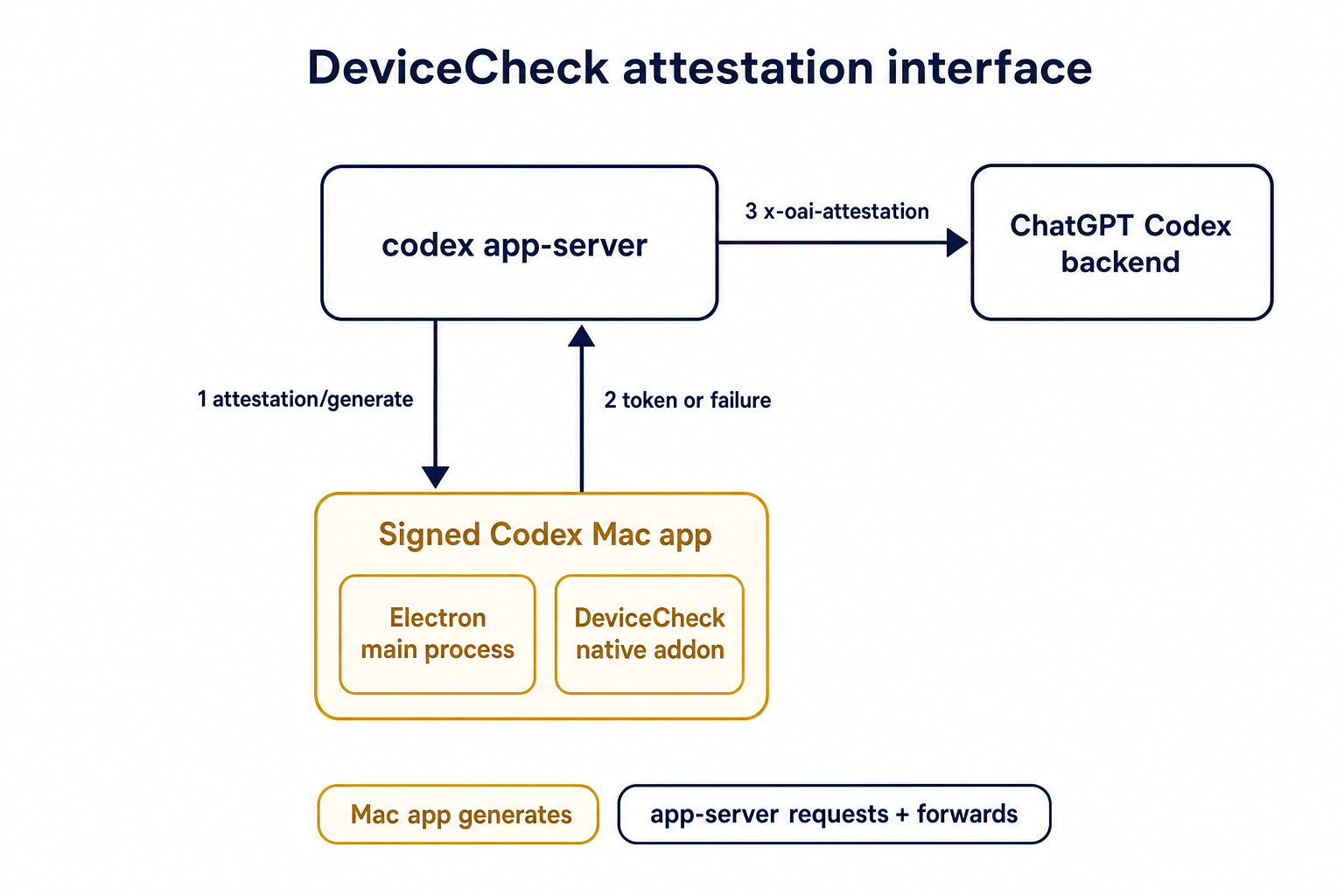
This PR teaches the Codex app-server runtime how to request and attach
an attestation token. It does not generate DeviceCheck tokens directly;
instead, it relies on the connected desktop app to advertise that it can
generate attestation and then asks that app for a fresh header value
when needed.
The flow is:
1. The Codex desktop app connects to app-server.
2. During `initialize`, the app can advertise that it supports
`requestAttestation`.
3. Before app-server calls selected ChatGPT Codex endpoints, it sends
the internal server request `attestation/generate` to the app.
4. app-server receives a pre-encoded header value back.
5. app-server forwards that value as `x-oai-attestation` on the scoped
outbound requests.
The code in this repo is mostly protocol and runtime plumbing: it adds
the app-server request/response shape, introduces an attestation
provider in core, wires that provider into Responses / compaction /
realtime setup paths, and covers the intended scoping with tests. The
signed macOS DeviceCheck generation remains owned by the desktop app PR.
## Related PR
- Codex desktop app implementation:
https://github.com/openai/openai/pull/878649
## Validation
<details>
<summary>Tests run</summary>
```sh
cargo test -p codex-app-server-protocol
cargo test -p codex-core attestation --lib
cargo test -p codex-app-server --lib attestation
```
Also ran:
```sh
just fix -p codex-core
just fix -p codex-app-server
just fix -p codex-app-server-protocol
just fmt
just write-app-server-schema
```
</details>
<details>
<summary>E2E DeviceCheck validation</summary>
First validated the signed desktop app boundary directly: launched a
packaged signed `Codex.app`, sent `attestation/generate`, decoded the
returned `v1.` attestation header, and validated the extracted
DeviceCheck token with `personal/jm/verify_devicecheck_token.py` using
bundle ID `com.openai.codex`. Apple returned `status_code: 200` and
`is_ok: true`.
Then ran the fuller app + app-server flow. The packaged `Codex.app`
launched a current-branch app-server via `CODEX_CLI_PATH`, and a local
MITM proxy intercepted outbound `chatgpt.com` traffic. The app-server
requested `attestation/generate` from the real Electron app process, and
the intercepted `/backend-api/codex/responses` traffic included
`x-oai-attestation` on both routes:
```text
GET /backend-api/codex/responses Upgrade: websocket x-oai-attestation: present
POST /backend-api/codex/responses Upgrade: none x-oai-attestation: present
```
The captured header decoded to a DeviceCheck token that also validated
with Apple for `com.openai.codex` (`status_code: 200`, `is_ok: true`,
team `2DC432GLL2`).
</details>
---------
Co-authored-by: Codex <noreply@openai.com>
## Description

This PR stops emitting legacy `codex/event/*` notifications from the
public app-server transports.

It's been a long time coming! app-server was still producing a raw
notification stream from core, alongside the typed app-server
notifications and server requests, for compatibility reasons. Now,
external clients should no longer be depending on those legacy
notifications, so this change removes them from the stdio and websocket
contract and updates the surrounding docs, examples, and tests to match.

### Caveat
I left the "in-process" version of app-server alone for now, since
`codex exec` was recently based on top of app-server via this in-process
form here: https://github.com/openai/codex/pull/14005

Seems like `codex exec` still consumes some legacy notifications
internally, so this branch only removes `codex/event/*` from app-server
over stdio and websockets.

## Follow-up

Once `codex exec` is fully migrated off `codex/event/*` notifications,
we'll be able to stop emitting them entirely entirely instead of just
filtering it at the external transport boundary.
## Problem being solved
- We need a single, reliable way to mark app-server API surface as
experimental so that:
  1. the runtime can reject experimental usage unless the client opts in
2. generated TS/JSON schemas can exclude experimental methods/fields for
stable clients.

Right now that’s easy to drift or miss when done ad-hoc.

## How to declare experimental methods and fields
- **Experimental method**: add `#[experimental("method/name")]` to the
`ClientRequest` variant in `client_request_definitions!`.
- **Experimental field**: on the params struct, derive `ExperimentalApi`
and annotate the field with `#[experimental("method/name.field")]` + set
`inspect_params: true` for the method variant so
`ClientRequest::experimental_reason()` inspects params for experimental
fields.

## How the macro solves it
- The new derive macro lives in
`codex-rs/codex-experimental-api-macros/src/lib.rs` and is used via
`#[derive(ExperimentalApi)]` plus `#[experimental("reason")]`
attributes.
- **Structs**:
- Generates `ExperimentalApi::experimental_reason(&self)` that checks
only annotated fields.
  - The “presence” check is type-aware:
    - `Option<T>`: `is_some_and(...)` recursively checks inner.
    - `Vec`/`HashMap`/`BTreeMap`: must be non-empty.
    - `bool`: must be `true`.
    - Other types: considered present (returns `true`).
- Registers each experimental field in an `inventory` with `(type_name,
serialized field name, reason)` and exposes `EXPERIMENTAL_FIELDS` for
that type. Field names are converted from `snake_case` to `camelCase`
for schema/TS filtering.
- **Enums**:
- Generates an exhaustive `match` returning `Some(reason)` for annotated
variants and `None` otherwise (no wildcard arm).
- **Wiring**:
- Runtime gating uses `ExperimentalApi::experimental_reason()` in
`codex-rs/app-server/src/message_processor.rs` to reject requests unless
`InitializeParams.capabilities.experimental_api == true`.
- Schema/TS export filters use the inventory list and
`EXPERIMENTAL_CLIENT_METHODS` from `client_request_definitions!` to
strip experimental methods/fields when `experimental_api` is false.
Similar to what @sayan-oai did in openai/codex#8956 for
`config.schema.json`, this PR updates the repo so that it includes the
output of `codex app-server generate-json-schema` and `codex app-server
generate-ts` and adds a test to verify it is in sync with the current
code.

Motivation:
- This makes any schema changes introduced by a PR transparent during
code review.
- In particular, this should help us catch PRs that would introduce a
non-backwards-compatible change to the app schema (eventually, this
should also be enforced by tooling).
- Once https://github.com/openai/codex/pull/10231 is in to formalize the
notion of "experimental" fields, we can work on ensuring the
non-experimental bits are backwards-compatible.

`codex-rs/app-server-protocol/tests/schema_fixtures.rs` was added as the
test and `just write-app-server-schema` can be use to generate the
vendored schema files.

Incidentally, when I run:

```
rg _ codex-rs/app-server-protocol/schema/typescript/v2
```

I see a number of `snake_case` names that should be `camelCase`.
Gabriel Peal ·
Jiaming Zhang ·
Owen Lin ·
jif-oai ·
Michael Bolin ·
