mirror of
https://github.com/pchuan98/codex.git
synced 2026-07-01 00:31:56 +08:00
dev
40 Commits
-
Support
openai/formextended form elicitations (#27500)# Summary Allow App Server clients to opt into `openai/form` MCP elicitations.
Gabriel Peal ·
2026-06-18 11:54:49 -07:00 -
unified-exec: retain PathUri in command events (#28780)
## Why App-server must report command events containing foreign-platform paths without changing existing client or rollout path-string formats. ## What changed - retain `PathUri` through exec command begin/end events - convert cwd values to `LegacyAppPathString` at the app-server compatibility boundary - drop command actions with foreign paths and log them - serialize rollout-trace cwd values using their inferred native path representation - restore Wine coverage for retained Windows cwd values and successful completion
Adam Perry @ OpenAI ·
2026-06-18 05:00:04 +00:00 -
Scope command approvals by execution environment (#28738)
## Why Command approval cache keys included the command and working directory, but not the execution environment. An approval for `/workspace` locally could therefore be reused for the same command and path on an executor. ## What changed - Include the selected environment ID in shell and unified-exec approval cache keys. - Carry that ID through the normal command approval request so clients can show which environment is being approved. - Expose the environment through app-server as a required nullable `environmentId` and show it in the inline TUI approval prompt. - Keep older recorded approval events compatible when the environment is absent. For example, `echo ok` in local `/workspace` and `echo ok` in executor `/workspace` now produce different approval keys and separate prompts. ## Scope This PR does not change network approvals, Guardian review actions, MCP elicitation, full-screen TUI rendering, or environment-ID validation. Remote `shell_command` execution itself remains in #28722; this PR only makes its approval key environment-aware.
jif ·
2026-06-17 19:52:43 +02:00 -
Clarify model-generated and legacy app path types (#28577)
## Why `ApiPathString` kind of implies that it can be used anywhere we pull a path out of JSON, but it's not really appropriate for tool arguments when the model might generate relative paths. Prefer `String` for model-generated paths and we can handle the conversion per feature for now and define a shared abstraction later if it makes sense. # What Rename `ApiPathString` to `AppLegacyPathString` to clarify its role. Expand the `path-types` skill to tell the model to leave tool args as bare strings.
Adam Perry @ OpenAI ·
2026-06-16 20:47:43 +00:00 -
Use ApiPathString in app-server filesystem permission paths (#28367)
## Why Clients running an app-server on one OS and an exec-server on another OS need to be able to pass sandbox config to app-server that refers to resources on the executor's foreign OS. ## What `AbsolutePathBuf` can't represent these paths and we don't want users to be exposed to `PathUri` yet, so this moves the public app-server API to be expressed in terms of `ApiPathString`. Stacked on #28165. - change app-server v2 filesystem permission paths, including legacy read/write roots, to `ApiPathString` - localize API paths through `PathUri` when converting into the current native core permission types - make path-bearing permission conversions fallible and surface localization failures instead of silently treating malformed grants as ordinary denials - propagate conversion failures through app-server and TUI approval handling - regenerate the app-server JSON and TypeScript schemas - leave migration TODOs on native-path conversions so they can be removed once core permission paths use `PathUri`
Adam Perry @ OpenAI ·
2026-06-15 19:25:54 -07:00 -
Add request_user_input auto-resolution window contract (#27256)
## Why `request_user_input` is moving beyond its original plan-mode-only workflow, and future default/goal-mode usage needs a way for the model to ask helpful but non-blocking questions without forcing the turn to wait forever. This PR adds an explicit `autoResolutionMs` contract so a later client/runtime change can auto-resolve unanswered prompts after a bounded window while leaving truly blocking questions unchanged. This is contract plumbing only; it does not implement the client-side timer or auto-selection behavior, and the model-facing description treats the field as reserved unless the current runtime explicitly supports auto-resolution. ## What Changed - Added optional `autoResolutionMs` to the model-facing `request_user_input` args and core `RequestUserInputEvent`. - Added model-facing schema text for `autoResolutionMs` while marking it reserved for runtimes that explicitly support auto-resolution. - Bounds `autoResolutionMs` to `60_000..=240_000` ms during argument normalization by clamping out-of-range model-provided values. - Propagated the field through app-server v2 `ToolRequestUserInputParams`, app-server request forwarding, generated TypeScript, and JSON schema fixtures. - Updated app-server, core, protocol, and TUI call sites/tests so omitted values preserve existing `None`/`null` behavior and coverage verifies a `Some(60_000)` round trip. ## Verification - `just test -p codex-app-server-protocol` - `just test -p codex-core request_user_input` - `just test -p codex-app-server request_user_input_round_trip` - `just test -p codex-tui request_user_input` - `just test -p codex-protocol`
Shijie Rao ·
2026-06-11 22:30:41 -07:00 -
Encrypt multi-agent v2 message payloads (#26210)
## Why Multi-agent v2 currently routes agent instructions through normal tool arguments and inter-agent context. That means the parent model can emit plaintext task text, Codex can persist it in history/rollouts, and the recipient can receive it as ordinary assistant-message JSON. This changes the v2 path so agent instructions stay encrypted between model calls: Responses encrypts the `message` argument returned by the model, Codex forwards only that ciphertext, and Responses decrypts it internally for the recipient model. ## What changed - Mark the v2 `message` parameter as encrypted for `spawn_agent`, `send_message`, and `followup_task`. - Treat multi-agent v2 tool `message` values as ciphertext unconditionally. - Store v2 inter-agent task text in `InterAgentCommunication.encrypted_content` with empty plaintext `content`. - Convert encrypted inter-agent communications into the Responses `agent_message` input item before sending the child request. - Preserve `agent_message` items across history, rollout, compaction, telemetry, and app-server schema paths. - Leave multi-agent v1 unchanged. ## Message shape The model still calls the v2 tools with a `message` argument, but that value is now ciphertext: ```json { "name": "spawn_agent", "arguments": { "task_name": "worker", "message": "<ciphertext>" } } ``` Codex stores the task as encrypted inter-agent communication: ```json { "author": "/root", "recipient": "/root/worker", "content": "", "encrypted_content": "<ciphertext>", "trigger_turn": true } ``` When Codex builds the recipient request, it forwards the ciphertext using the new Responses input item: ```json { "type": "agent_message", "author": "/root", "recipient": "/root/worker", "content": [ { "type": "encrypted_content", "encrypted_content": "<ciphertext>" } ] } ``` Responses decrypts that item internally for the recipient model. ## Context impact - Parent context no longer carries plaintext v2 agent task instructions from these tool arguments. - Codex rollout/history stores ciphertext for v2 agent instructions. - Recipient requests receive an `agent_message` item instead of assistant commentary JSON for encrypted task delivery. - Plaintext completion/status notifications are still plaintext because they are Codex-generated status messages, not encrypted model tool arguments. ## Validation - `just test -p codex-tools` - `just test -p codex-protocol` - `just test -p codex-rollout` - `just test -p codex-rollout-trace` - `just test -p codex-otel` - `just write-app-server-schema`jif ·
2026-06-05 10:25:57 +02:00 -
Propagate permission approval environment id (#25862)
## Stack 1. #25850 - Key request-permission grants by environment: stores and applies sticky permission grants per environment id. 2. #25858 - Add `environmentId` to `request_permissions`: lets the model target a selected environment and resolves relative permission paths against it. 3. This PR (#25862) - Propagate permission approval environment id: carries the selected environment id through approval events, app-server requests, TUI prompts, and delegate forwarding. 4. #25867 - Add remote request permissions integration coverage: verifies the selected remote environment across request, approval, grant reuse, and exec. This PR is stacked on #25858, and #25867 is stacked on this PR. ## Why PR2 lets the model bind a `request_permissions` call to a selected environment, but the approval event and client-facing request still needed to carry that binding. For CCA, the user-facing prompt and delegated approval path should know which environment the grant applies to instead of relying on cwd alone. ## What Changed - Added optional `environmentId` to `RequestPermissionsEvent`. - Emit the selected environment id from core permission approval events. - Preserve the environment id through delegate forwarding, including cwd-based delegated requests. - Added `environmentId` to app-server permission approval params, generated schema/TypeScript artifacts, and README examples. - Preserve and display the environment id in TUI permission approval prompts. - Updated focused core, app-server protocol, and TUI conversion coverage. ## Testing Not run locally per instruction. Performed read-only `git diff --check`.
jif ·
2026-06-02 21:09:34 +02:00 -
Make
denycanonical for filesystem permission entries (#23493)## Why Filesystem permission profiles used `none` for deny-read entries, which is less direct than the action the entry actually represents. This change makes `deny` the canonical filesystem permission spelling while preserving compatibility for older configs that still send `none`. ## What changed - rename `FileSystemAccessMode::None` to `Deny` - serialize and generate schemas with `deny` as the canonical value - retain `none` only as a legacy input alias for temporary config compatibility - update filesystem glob diagnostics and regression coverage to use the canonical spelling - refresh config and app-server schema fixtures to match the new wire shape ## Validation - `cargo test -p codex-protocol` - `cargo test -p codex-app-server-protocol` - `cargo test -p codex-core config_toml_deserializes_permission_profiles --lib` - `cargo test -p codex-core read_write_glob_patterns_still_reject_non_subpath_globs --lib` Earlier in the session, a broad `cargo test -p codex-core` run reached unrelated pre-existing failures in timing/snapshot/git-info tests under this environment; the targeted surfaces touched by this PR passed cleanly.
viyatb-oai ·
2026-05-19 11:03:47 -07:00 -
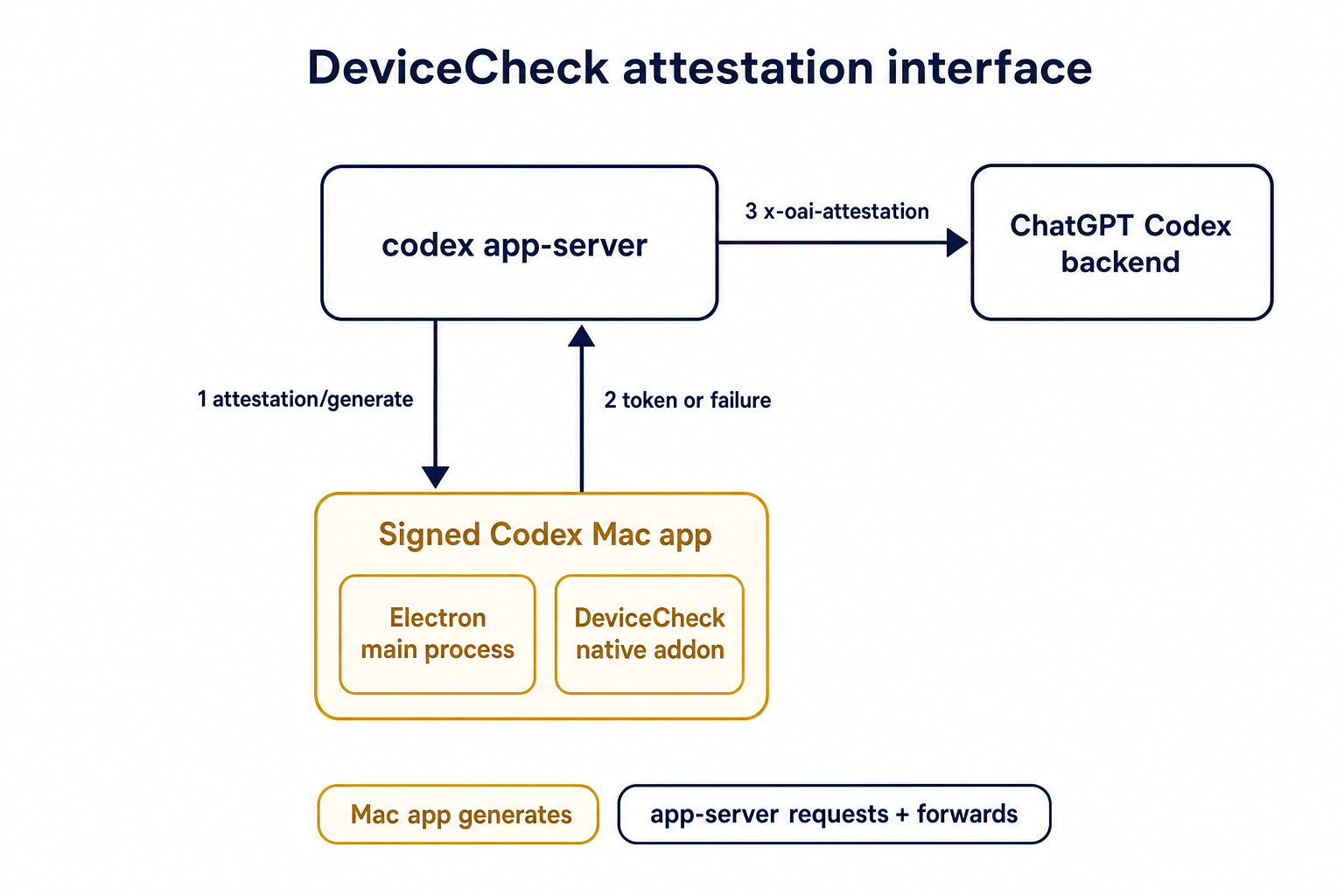
[codex] request desktop attestation from app (#20619)
## Summary TL;DR: teaches `codex-rs` / app-server to request a desktop-provided attestation token and attach it as `x-oai-attestation` on the scoped ChatGPT Codex request paths.  ## Details This PR teaches the Codex app-server runtime how to request and attach an attestation token. It does not generate DeviceCheck tokens directly; instead, it relies on the connected desktop app to advertise that it can generate attestation and then asks that app for a fresh header value when needed. The flow is: 1. The Codex desktop app connects to app-server. 2. During `initialize`, the app can advertise that it supports `requestAttestation`. 3. Before app-server calls selected ChatGPT Codex endpoints, it sends the internal server request `attestation/generate` to the app. 4. app-server receives a pre-encoded header value back. 5. app-server forwards that value as `x-oai-attestation` on the scoped outbound requests. The code in this repo is mostly protocol and runtime plumbing: it adds the app-server request/response shape, introduces an attestation provider in core, wires that provider into Responses / compaction / realtime setup paths, and covers the intended scoping with tests. The signed macOS DeviceCheck generation remains owned by the desktop app PR. ## Related PR - Codex desktop app implementation: https://github.com/openai/openai/pull/878649 ## Validation <details> <summary>Tests run</summary> ```sh cargo test -p codex-app-server-protocol cargo test -p codex-core attestation --lib cargo test -p codex-app-server --lib attestation ``` Also ran: ```sh just fix -p codex-core just fix -p codex-app-server just fix -p codex-app-server-protocol just fmt just write-app-server-schema ``` </details> <details> <summary>E2E DeviceCheck validation</summary> First validated the signed desktop app boundary directly: launched a packaged signed `Codex.app`, sent `attestation/generate`, decoded the returned `v1.` attestation header, and validated the extracted DeviceCheck token with `personal/jm/verify_devicecheck_token.py` using bundle ID `com.openai.codex`. Apple returned `status_code: 200` and `is_ok: true`. Then ran the fuller app + app-server flow. The packaged `Codex.app` launched a current-branch app-server via `CODEX_CLI_PATH`, and a local MITM proxy intercepted outbound `chatgpt.com` traffic. The app-server requested `attestation/generate` from the real Electron app process, and the intercepted `/backend-api/codex/responses` traffic included `x-oai-attestation` on both routes: ```text GET /backend-api/codex/responses Upgrade: websocket x-oai-attestation: present POST /backend-api/codex/responses Upgrade: none x-oai-attestation: present ``` The captured header decoded to a DeviceCheck token that also validated with Apple for `com.openai.codex` (`status_code: 200`, `is_ok: true`, team `2DC432GLL2`). </details> --------- Co-authored-by: Codex <noreply@openai.com>
Jiaming Zhang ·
2026-05-08 12:36:02 -07:00 -
[codex-analytics] plumb protocol-native review timing (#21434)
## Why We want terminal tool review analytics, but the reducer should not stamp review timing from its own wall clock. This PR plumbs review timing through the real protocol and app-server seams so downstream analytics can consume the emitter's timestamps directly. Guardian reviews keep their enriched `started_at` / `completed_at` analytics fields by deriving those legacy second-based values from the same protocol-native millisecond lifecycle timestamps, rather than sampling a separate analytics clock. ## What changed - add `started_at_ms` to user approval request payloads - add `started_at_ms` / `completed_at_ms` to guardian review notifications - preserve Guardian review `started_at` / `completed_at` enrichment from the protocol-native timing source - stamp typed `ServerResponse` analytics facts with app-server-observed `completed_at_ms` - thread the new timing fields through core, protocol, app-server, TUI, and analytics fixtures ## Verification - `cargo test -p codex-app-server outgoing_message --manifest-path codex-rs/Cargo.toml` - `cargo test -p codex-app-server-protocol guardian --manifest-path codex-rs/Cargo.toml` - `cargo test -p codex-tui guardian --manifest-path codex-rs/Cargo.toml` - `cargo test -p codex-analytics analytics_client_tests --manifest-path codex-rs/Cargo.toml` --- [//]: # (BEGIN SAPLING FOOTER) Stack created with [Sapling](https://sapling-scm.com). Best reviewed with [ReviewStack](https://reviewstack.dev/openai/codex/pull/21434). * #18748 * __->__ #21434 * #18747 * #17090 * #17089 * #20514
rhan-oai ·
2026-05-07 20:31:41 -07:00 -
permissions: remove cwd special path (#19841)
## Why The experimental `PermissionProfile` API had both `:cwd` and `:project_roots` special filesystem paths, which made the permission root ambiguous. This PR removes the unstable `current_working_directory` special path before the permissions API is stabilized, so callers use `:project_roots` for symbolic project-root access. ## What changed - Removes `FileSystemSpecialPath::CurrentWorkingDirectory` from protocol and app-server protocol models, plus regenerated app-server JSON/TypeScript schemas. - Replaces internal `:cwd` permission entries with `:project_roots` entries. - Keeps the existing cwd-update behavior for legacy-shaped workspace-write profiles, while removing the deleted `CurrentWorkingDirectory` case from that compatibility path. - Keeps `PermissionProfile::workspace_write()` as the reusable symbolic workspace-write helper, with docs noting that `:project_roots` entries resolve at enforcement time. - Updates app-server docs/examples and approval UI labeling to stop advertising `:cwd` as a permission token. ## Compatibility Persisted rollout items may contain the old `{"kind":"current_working_directory"}` tag from earlier experimental `permissionProfile` snapshots. This PR keeps that tag as a deserialize-only alias for `ProjectRoots { subpath: None }`, while continuing to serialize only the new `project_roots` tag. ## Follow-up This PR intentionally does not introduce an explicit project-root set on `SessionConfiguration` or runtime sandbox resolution. Today, the resolver still uses the active cwd as the single implicit project root. A follow-up should model project roots separately from tool cwd so `:project_roots` entries can resolve against the configured project roots, and resolve to no entries when there are no project roots. ## Verification - `cargo test -p codex-protocol permissions:: --lib` - `cargo test -p codex-app-server-protocol` - `cargo test -p codex-sandboxing -p codex-exec-server --lib` - `cargo test -p codex-core session_configuration_apply_ --lib` - `cargo test -p codex-app-server command_exec_permission_profile_project_roots_use_command_cwd --test all` - `cargo test -p codex-tui thread_read_session_state_does_not_reuse_primary_permission_profile --lib` - `cargo test -p codex-tui preset_matching_accepts_workspace_write_with_extra_roots --lib` - `cargo test -p codex-config --lib`Michael Bolin ·
2026-04-27 13:41:27 -07:00 -
permissions: make profiles represent enforcement (#19231)
## Why `PermissionProfile` is becoming the canonical permissions abstraction, but the old shape only carried optional filesystem and network fields. It could describe allowed access, but not who is responsible for enforcing it. That made `DangerFullAccess` and `ExternalSandbox` lossy when profiles were exported, cached, or round-tripped through app-server APIs. The important model change is that active permissions are now a disjoint union over the enforcement mode. Conceptually: ```rust pub enum PermissionProfile { Managed { file_system: FileSystemSandboxPolicy, network: NetworkSandboxPolicy, }, Disabled, External { network: NetworkSandboxPolicy, }, } ``` This distinction matters because `Disabled` means Codex should apply no outer sandbox at all, while `External` means filesystem isolation is owned by an outside caller. Those are not equivalent to a broad managed sandbox. For example, macOS cannot nest Seatbelt inside Seatbelt, so an inner sandbox may require the outer Codex layer to use no sandbox rather than a permissive one. ## How Existing Modeling Maps Legacy `SandboxPolicy` remains a boundary projection, but it now maps into the higher-fidelity profile model: - `ReadOnly` and `WorkspaceWrite` map to `PermissionProfile::Managed` with restricted filesystem entries plus the corresponding network policy. - `DangerFullAccess` maps to `PermissionProfile::Disabled`, preserving the “no outer sandbox” intent instead of treating it as a lax managed sandbox. - `ExternalSandbox { network_access }` maps to `PermissionProfile::External { network }`, preserving external filesystem enforcement while still carrying the active network policy. - Split runtime policies that legacy `SandboxPolicy` cannot faithfully express, such as managed unrestricted filesystem plus restricted network, stay `Managed` instead of being collapsed into `ExternalSandbox`. - Per-command/session/turn grants remain partial overlays via `AdditionalPermissionProfile`; full `PermissionProfile` is reserved for complete active runtime permissions. ## What Changed - Change active `PermissionProfile` into a tagged union: `managed`, `disabled`, and `external`. - Keep partial permission grants separate with `AdditionalPermissionProfile` for command/session/turn overlays. - Represent managed filesystem permissions as either `restricted` entries or `unrestricted`; `glob_scan_max_depth` is non-zero when present. - Preserve old rollout compatibility by accepting the pre-tagged `{ network, file_system }` profile shape during deserialization. - Preserve fidelity for important edge cases: `DangerFullAccess` round-trips as `disabled`, `ExternalSandbox` round-trips as `external`, and managed unrestricted filesystem + restricted network stays managed instead of being mistaken for external enforcement. - Preserve configured deny-read entries and bounded glob scan depth when full profiles are projected back into runtime policies, including unrestricted replacements that now become `:root = write` plus deny entries. - Regenerate the experimental app-server v2 JSON/TypeScript schema and update the `command/exec` README example for the tagged `permissionProfile` shape. ## Compatibility Legacy `SandboxPolicy` remains available at config/API boundaries as the compatibility projection. Existing rollout lines with the old `PermissionProfile` shape continue to load. The app-server `permissionProfile` field is experimental, so its v2 wire shape is intentionally updated to match the higher-fidelity model. ## Verification - `just write-app-server-schema` - `cargo check --tests` - `cargo test -p codex-protocol permission_profile` - `cargo test -p codex-protocol preserving_deny_entries_keeps_unrestricted_policy_enforceable` - `cargo test -p codex-app-server-protocol permission_profile_file_system_permissions` - `cargo test -p codex-app-server-protocol serialize_client_response` - `cargo test -p codex-core session_configured_reports_permission_profile_for_external_sandbox` - `just fix` - `just fix -p codex-protocol` - `just fix -p codex-app-server-protocol` - `just fix -p codex-core` - `just fix -p codex-app-server`Michael Bolin ·
2026-04-23 23:02:18 -07:00 -
app-server: include filesystem entries in permission requests (#19086)
## Why `item/permissions/requestApproval` sends a requested permission profile to app-server clients. The core profile already stores filesystem permissions as `entries`, but the v2 compatibility conversion used the legacy `read`/`write` projection whenever possible and left `entries` unset. That made the request ambiguous for clients that consume the canonical v2 shape: `permissions.fileSystem.entries` was missing even though filesystem access was being requested. A client that rendered or echoed grants from `entries` could treat the request as having no filesystem permission entries, then return an empty or incomplete grant. The app-server intersects responses with the original request, so omitted filesystem permissions are denied. ## What Changed - Populate `AdditionalFileSystemPermissions.entries` when converting legacy read/write roots for request permission payloads, while preserving `read` and `write` for compatibility. - Mark `read` and `write` as transitional schema fields in the generated app-server schema. - Add regression coverage for the v2 conversion, the app-server `item/permissions/requestApproval` round trip, and TUI app-server approval conversion expectations. - Refresh generated JSON and TypeScript schema fixtures. ## Verification - `just fmt` - `cargo test -p codex-app-server-protocol` - `cargo test -p codex-app-server request_permissions_round_trip` - `cargo test -p codex-tui converts_request_permissions_into_granted_permissions` - `cargo test -p codex-tui resolves_permissions_and_user_input_through_app_server_request_id`
Michael Bolin ·
2026-04-23 00:21:59 -07:00 -
sandboxing: intersect permission profiles semantically (#18275)
## Why Permission approval responses must not be able to grant more access than the tool requested. Moving this flow to `PermissionProfile` means the comparison must be profile-shaped instead of `SandboxPolicy`-shaped, and cwd-relative special paths such as `:cwd` and `:project_roots` must stay anchored to the turn that produced the request. ## What changed This implements semantic `PermissionProfile` intersection in `codex-sandboxing` for file-system and network permissions. The intersection accepts narrower path grants, rejects broader grants, preserves deny-read carve-outs and glob scan depth, and materializes cwd-dependent special-path grants to absolute paths before they can be recorded for reuse. The request-permissions response paths now use that intersection consistently. App-server captures the request turn cwd before waiting for the client response, includes that cwd in the v2 approval params, and core stores the requested profile plus cwd for direct TUI/client responses and Guardian decisions before recording turn- or session-scoped grants. The TUI app-server bridge now preserves the app-server request cwd when converting permission approval params into core events. ## Verification - `cargo test -p codex-sandboxing intersect_permission_profiles -- --nocapture` - `cargo test -p codex-app-server request_permissions_response -- --nocapture` - `cargo test -p codex-core request_permissions_response_materializes_session_cwd_grants_before_recording -- --nocapture` - `cargo check -p codex-tui --tests` - `cargo check --tests` - `cargo test -p codex-tui app_server_request_permissions_preserves_file_system_permissions`
Michael Bolin ·
2026-04-21 10:23:01 -07:00 -
[tool search] support namespaced deferred dynamic tools (#18413)
Deferred dynamic tools need to round-trip a namespace so a tool returned by `tool_search` can be called through the same registry key that core uses for dispatch. This change adds namespace support for dynamic tool specs/calls, persists it through app-server thread state, and routes dynamic tool calls by full `ToolName` while still sending the app the leaf tool name. Deferred dynamic tools must provide a namespace; non-deferred dynamic tools may remain top-level. It also introduces `LoadableToolSpec` as the shared function-or-namespace Responses shape used by both `tool_search` output and dynamic tool registration, so dynamic tools use the same wrapping logic in both paths. Validation: - `cargo test -p codex-tools` - `cargo test -p codex-core tool_search` --------- Co-authored-by: Sayan Sisodiya <sayan@openai.com>
pash-openai ·
2026-04-21 14:13:08 +08:00 -
protocol: preserve glob scan depth in permission profiles (#18713)
## Why #18274 made `PermissionProfile` the canonical file-system permissions shape, but the round-trip from `FileSystemSandboxPolicy` to `PermissionProfile` still dropped one piece of policy metadata: `glob_scan_max_depth`. That field is security-relevant for deny-read globs such as `**/*.env`. On Linux, bubblewrap sandbox construction uses it to bound unreadable glob expansion. If a profile copied from active runtime permissions loses this value and is submitted back as an override, the resulting `FileSystemSandboxPolicy` can behave differently even though the visible permission entries look equivalent. ## What changed - Add `glob_scan_max_depth` to protocol `FileSystemPermissions` and preserve it when converting to/from `FileSystemSandboxPolicy`. - Keep legacy `read`/`write` JSON for simple path-only permissions, but force canonical JSON when glob scan depth is present so the metadata is not silently dropped. - Carry `globScanMaxDepth` through app-server `AdditionalFileSystemPermissions`, generated JSON/TypeScript schemas, and app-server/TUI conversion call sites. - Preserve the metadata through sandboxing permission normalization, merging, and intersection. - Carry the merged scan depth into the effective `FileSystemSandboxPolicy` used for command execution, so bounded deny-read globs reach Linux bubblewrap materialization. ## Verification - `cargo test -p codex-sandboxing glob_scan -- --nocapture` - `cargo test -p codex-sandboxing policy_transforms -- --nocapture` - `just fix -p codex-sandboxing` --- [//]: # (BEGIN SAPLING FOOTER) Stack created with [Sapling](https://sapling-scm.com). Best reviewed with [ReviewStack](https://reviewstack.dev/openai/codex/pull/18713). * #18288 * #18287 * #18286 * #18285 * #18284 * #18283 * #18282 * #18281 * #18280 * #18279 * #18278 * #18277 * #18276 * #18275 * __->__ #18713
Michael Bolin ·
2026-04-20 19:42:45 -07:00 -
protocol: canonicalize file system permissions (#18274)
## Why `PermissionProfile` needs stable, canonical file-system semantics before it can become the primary runtime permissions abstraction. Without a canonical form, callers have to keep re-deriving legacy sandbox maps and profile comparisons remain lossy or order-dependent. ## What changed This adds canonicalization helpers for `FileSystemPermissions` and `PermissionProfile`, expands special paths into explicit sandbox entries, and updates permission request/conversion paths to consume those canonical entries. It also tightens the legacy bridge so root-wide write profiles with narrower carveouts are not silently projected as full-disk legacy access. ## Verification - `cargo test -p codex-protocol root_write_with_read_only_child_is_not_full_disk_write -- --nocapture` - `cargo test -p codex-sandboxing permission -- --nocapture` - `cargo test -p codex-tui permissions -- --nocapture`
Michael Bolin ·
2026-04-20 09:57:03 -07:00 -
Spread AbsolutePathBuf (#17792)
Mechanical change to promote absolute paths through code.
pakrym-oai ·
2026-04-14 14:26:10 -07:00 -
permissions: remove macOS seatbelt extension profiles (#15918)
## Why `PermissionProfile` should only describe the per-command permissions we still want to grant dynamically. Keeping `MacOsSeatbeltProfileExtensions` in that surface forced extra macOS-only approval, protocol, schema, and TUI branches for a capability we no longer want to expose. ## What changed - Removed the macOS-specific permission-profile types from `codex-protocol`, the app-server v2 API, and the generated schema/TypeScript artifacts. - Deleted the core and sandboxing plumbing that threaded `MacOsSeatbeltProfileExtensions` through execution requests and seatbelt construction. - Simplified macOS seatbelt generation so it always includes the fixed read-only preferences allowlist instead of carrying a configurable profile extension. - Removed the macOS additional-permissions UI/docs/test coverage and deleted the obsolete macOS permission modules. - Tightened `request_permissions` intersection handling so explicitly empty requested read lists are preserved only when that field was actually granted, avoiding zero-grant responses being stored as active permissions.
Michael Bolin ·
2026-03-26 17:12:45 -07:00 -
chore: remove skill metadata from command approval payloads (#15906)
## Why This is effectively a follow-up to [#15812](https://github.com/openai/codex/pull/15812). That change removed the special skill-script exec path, but `skill_metadata` was still being threaded through command-approval payloads even though the approval flow no longer uses it to render prompts or resolve decisions. Keeping it around added extra protocol, schema, and client surface area without changing behavior. Removing it keeps the command-approval contract smaller and avoids carrying a dead field through app-server, TUI, and MCP boundaries. ## What changed - removed `ExecApprovalRequestSkillMetadata` and the corresponding `skillMetadata` field from core approval events and the v2 app-server protocol - removed the generated JSON and TypeScript schema output for that field - updated app-server, MCP server, TUI, and TUI app-server approval plumbing to stop forwarding the field - cleaned up tests that previously constructed or asserted `skillMetadata` ## Testing - `cargo test -p codex-app-server-protocol` - `cargo test -p codex-protocol` - `cargo test -p codex-app-server-test-client` - `cargo test -p codex-mcp-server` - `just argument-comment-lint`
Michael Bolin ·
2026-03-26 15:32:03 -07:00 -
Jack Mousseau ·
2026-03-16 10:12:23 -07:00 -
feat: Add additional macOS Sandbox Permissions for Launch Services, Contacts, Reminders (#14155)
Add additional macOS Sandbox Permissions levers for the following: - Launch Services - Contacts - Reminders
Leo Shimonaka ·
2026-03-11 12:33:09 -07:00 -
Add request permissions tool (#13092)
Adds a built-in `request_permissions` tool and wires it through the Codex core, protocol, and app-server layers so a running turn can ask the client for additional permissions instead of relying on a static session policy. The new flow emits a `RequestPermissions` event from core, tracks the pending request by call ID, forwards it through app-server v2 as an `item/permissions/requestApproval` request, and resumes the tool call once the client returns an approved subset of the requested permission profile.
Jack Mousseau ·
2026-03-08 20:23:06 -07:00 -
app-server: include experimental skill metadata in exec approval requests (#13929)
## Summary This change surfaces skill metadata on command approval requests so app-server clients can tell when an approval came from a skill script and identify the originating `SKILL.md`. - add `skill_metadata` to exec approval events in the shared protocol - thread skill metadata through core shell escalation and delegated approval handling for skill-triggered approvals - expose the field in app-server v2 as experimental `skillMetadata` - regenerate the JSON/TypeScript schemas and cover the new field in protocol, transport, core, and TUI tests ## Why Skill-triggered approvals already carry skill context inside core, but app-server clients could not see which skill caused the prompt. Sending the skill metadata with the approval request makes it possible for clients to present better approval UX and connect the prompt back to the relevant skill definition. ## example event in app-server-v2 verified that we see this event when experimental api is on: ``` < { < "id": 11, < "method": "item/commandExecution/requestApproval", < "params": { < "additionalPermissions": { < "fileSystem": null, < "macos": { < "accessibility": false, < "automations": { < "bundle_ids": [ < "com.apple.Notes" < ] < }, < "calendar": false, < "preferences": "read_only" < }, < "network": null < }, < "approvalId": "25d600ee-5a3c-4746-8d17-e2e61fb4c563", < "availableDecisions": [ < "accept", < "acceptForSession", < "cancel" < ], < "command": "/Applications/ChatGPT.app/Contents/Resources/CodexAppServer_CodexAppServerBundledSkills.bundle/Contents/Resources/skills/apple-notes/scripts/notes_info", < "commandActions": [ < { < "command": "/Applications/ChatGPT.app/Contents/Resources/CodexAppServer_CodexAppServerBundledSkills.bundle/Contents/Resources/skills/apple-notes/scripts/notes_info", < "type": "unknown" < } < ], < "cwd": "/Applications/ChatGPT.app/Contents/Resources/CodexAppServer_CodexAppServerBundledSkills.bundle/Contents/Resources/skills/apple-notes", < "itemId": "call_jZp3xFpNg4D8iKAD49cvEvZy", < "skillMetadata": { < "pathToSkillsMd": "/Applications/ChatGPT.app/Contents/Resources/CodexAppServer_CodexAppServerBundledSkills.bundle/Contents/Resources/skills/apple-notes/SKILL.md" < }, < "threadId": "019ccc10-b7d3-7ff2-84fe-3a75e7681e69", < "turnId": "019ccc10-b848-76f1-81b3-4a1fa225493f" < } < }` ``` & verified that this is the event when experimental api is off: ``` < { < "id": 13, < "method": "item/commandExecution/requestApproval", < "params": { < "approvalId": "5fbbf776-261b-4cf8-899b-c125b547f2c0", < "availableDecisions": [ < "accept", < "acceptForSession", < "cancel" < ], < "command": "/Applications/ChatGPT.app/Contents/Resources/CodexAppServer_CodexAppServerBundledSkills.bundle/Contents/Resources/skills/apple-notes/scripts/notes_info", < "commandActions": [ < { < "command": "/Applications/ChatGPT.app/Contents/Resources/CodexAppServer_CodexAppServerBundledSkills.bundle/Contents/Resources/skills/apple-notes/scripts/notes_info", < "type": "unknown" < } < ], < "cwd": "/Users/celia/code/codex/codex-rs", < "itemId": "call_OV2DHzTgYcbYtWaTTBWlocOt", < "threadId": "019ccc16-2a2b-7be1-8500-e00d45b892d4", < "turnId": "019ccc16-2a8e-7961-98ec-649600e7d06a" < } < } ```Celia Chen ·
2026-03-08 18:07:46 -07:00 -
[elicitations] Switch to use MCP style elicitation payload for mcp tool approvals. (#13621)
- [x] Switch to use MCP style elicitation payload for mcp tool approvals. - [ ] TODO: Update the UI to support the full spec.
Matthew Zeng ·
2026-03-06 01:50:26 -08:00 -
core/protocol: add structured macOS additional permissions and merge them into sandbox execution (#13499)
## Summary - Introduce strongly-typed macOS additional permissions across protocol/core/app-server boundaries. - Merge additional permissions into effective sandbox execution, including macOS seatbelt profile extensions. - Expand docs, schema/tool definitions, UI rendering, and tests for `network`, `file_system`, and `macos` additional permissions.
Celia Chen ·
2026-03-05 16:21:45 -08:00 -
feat(app-server): support mcp elicitations in v2 api (#13425)
This adds a first-class server request for MCP server elicitations: `mcpServer/elicitation/request`. Until now, MCP elicitation requests only showed up as a raw `codex/event/elicitation_request` event from core. That made it hard for v2 clients to handle elicitations using the same request/response flow as other server-driven interactions (like shell and `apply_patch` tools). This also updates the underlying MCP elicitation request handling in core to pass through the full MCP request (including URL and form data) so we can expose it properly in app-server. ### Why not `item/mcpToolCall/elicitationRequest`? This is because MCP elicitations are related to MCP servers first, and only optionally to a specific MCP tool call. In the MCP protocol, elicitation is a server-to-client capability: the server sends `elicitation/create`, and the client replies with an elicitation result. RMCP models it that way as well. In practice an elicitation is often triggered by an MCP tool call, but not always. ### What changed - add `mcpServer/elicitation/request` to the v2 app-server API - translate core `codex/event/elicitation_request` events into the new v2 server request - map client responses back into `Op::ResolveElicitation` so the MCP server can continue - update app-server docs and generated protocol schema - add an end-to-end app-server test that covers the full round trip through a real RMCP elicitation flow - The new test exercises a realistic case where an MCP tool call triggers an elicitation, the app-server emits mcpServer/elicitation/request, the client accepts it, and the tool call resumes and completes successfully. ### app-server API flow - Client starts a thread with `thread/start`. - Client starts a turn with `turn/start`. - App-server sends `item/started` for the `mcpToolCall`. - While that tool call is in progress, app-server sends `mcpServer/elicitation/request`. - Client responds to that request with `{ action: "accept" | "decline" | "cancel" }`. - App-server sends `serverRequest/resolved`. - App-server sends `item/completed` for the mcpToolCall. - App-server sends `turn/completed`. - If the turn is interrupted while the elicitation is pending, app-server still sends `serverRequest/resolved` before the turn finishes.Owen Lin ·
2026-03-05 07:20:20 -08:00 -
chore: Nest skill and protocol network permissions under
network.enabled(#13427)## Summary Changes the permission profile shape from a bare network boolean to a nested object. Before: ```yaml permissions: network: true ``` After: ```yaml permissions: network: enabled: true ``` This also updates the shared Rust and app-server protocol types so `PermissionProfile.network` is no longer `Option<bool>`, but `Option<NetworkPermissions>` with `enabled: Option<bool>`. ## What Changed - Updated `PermissionProfile` in `codex-rs/protocol/src/models.rs`: - `pub network: Option<bool>` -> `pub network: Option<NetworkPermissions>` - Added `NetworkPermissions` with: - `pub enabled: Option<bool>` - Changed emptiness semantics so `network` is only considered empty when `enabled` is `None` - Updated skill metadata parsing to accept `permissions.network.enabled` - Updated core permission consumers to read `network.enabled.unwrap_or(false)` where a concrete boolean is needed - Updated app-server v2 protocol types and regenerated schema/TypeScript outputs - Updated docs to mention `additionalPermissions.network.enabled`Celia Chen ·
2026-03-03 20:57:29 -08:00 -
fix: use AbsolutePathBuf for permission profile file roots (#12970)
## Why `PermissionProfile` should describe filesystem roots as absolute paths at the type level. Using `PathBuf` in `FileSystemPermissions` made the shared type too permissive and blurred together three different deserialization cases: - skill metadata in `agents/openai.yaml`, where relative paths should resolve against the skill directory - app-server API payloads, where callers should have to send absolute paths - local tool-call payloads for commands like `shell_command` and `exec_command`, where `additional_permissions.file_system` may legitimately be relative to the command `workdir` This change tightens the shared model without regressing the existing local command flow. ## What Changed - changed `protocol::models::FileSystemPermissions` and the app-server `AdditionalFileSystemPermissions` mirror to use `AbsolutePathBuf` - wrapped skill metadata deserialization in `AbsolutePathBufGuard`, so relative permission roots in `agents/openai.yaml` resolve against the containing skill directory - kept app-server/API deserialization strict, so relative `additionalPermissions.fileSystem.*` paths are rejected at the boundary - restored cwd/workdir-relative deserialization for local tool-call payloads by parsing `shell`, `shell_command`, and `exec_command` arguments under an `AbsolutePathBufGuard` rooted at the resolved command working directory - simplified runtime additional-permission normalization so it only canonicalizes and deduplicates absolute roots instead of trying to recover relative ones later - updated the app-server schema fixtures, `app-server/README.md`, and the affected transport/TUI tests to match the final behavior
Michael Bolin ·
2026-02-27 17:42:52 +00:00 -
feat: include available decisions in command approval requests (#12758)
Command-approval clients currently infer which choices to show from side-channel fields like `networkApprovalContext`, `proposedExecpolicyAmendment`, and `additionalPermissions`. That makes the request shape harder to evolve, and it forces each client to replicate the server's heuristics instead of receiving the exact decision list for the prompt. This PR introduces a mapping between `CommandExecutionApprovalDecision` and `codex_protocol::protocol::ReviewDecision`: ```rust impl From<CoreReviewDecision> for CommandExecutionApprovalDecision { fn from(value: CoreReviewDecision) -> Self { match value { CoreReviewDecision::Approved => Self::Accept, CoreReviewDecision::ApprovedExecpolicyAmendment { proposed_execpolicy_amendment, } => Self::AcceptWithExecpolicyAmendment { execpolicy_amendment: proposed_execpolicy_amendment.into(), }, CoreReviewDecision::ApprovedForSession => Self::AcceptForSession, CoreReviewDecision::NetworkPolicyAmendment { network_policy_amendment, } => Self::ApplyNetworkPolicyAmendment { network_policy_amendment: network_policy_amendment.into(), }, CoreReviewDecision::Abort => Self::Cancel, CoreReviewDecision::Denied => Self::Decline, } } } ``` And updates `CommandExecutionRequestApprovalParams` to have a new field: ```rust available_decisions: Option<Vec<CommandExecutionApprovalDecision>> ``` when, if specified, should make it easier for clients to display an appropriate list of options in the UI. This makes it possible for `CoreShellActionProvider::prompt()` in `unix_escalation.rs` to specify the `Vec<ReviewDecision>` directly, adding support for `ApprovedForSession` when approving a skill script, which was previously missing in the TUI. Note this results in a significant change to `exec_options()` in `approval_overlay.rs`, as the displayed options are now derived from `available_decisions: &[ReviewDecision]`. ## What Changed - Add `available_decisions` to [`ExecApprovalRequestEvent`](https://github.com/openai/codex/blob/de00e932dd9801de0a4faac0519162099753f331/codex-rs/protocol/src/approvals.rs#L111-L175), including helpers to derive the legacy default choices when older senders omit the field. - Map `codex_protocol::protocol::ReviewDecision` to app-server `CommandExecutionApprovalDecision` and expose the ordered list as experimental `availableDecisions` in [`CommandExecutionRequestApprovalParams`](https://github.com/openai/codex/blob/de00e932dd9801de0a4faac0519162099753f331/codex-rs/app-server-protocol/src/protocol/v2.rs#L3798-L3807). - Thread optional `available_decisions` through the core approval path so Unix shell escalation can explicitly request `ApprovedForSession` for session-scoped approvals instead of relying on client heuristics. [`unix_escalation.rs`](https://github.com/openai/codex/blob/de00e932dd9801de0a4faac0519162099753f331/codex-rs/core/src/tools/runtimes/shell/unix_escalation.rs#L194-L214) - Update the TUI approval overlay to build its buttons from the ordered decision list, while preserving the legacy fallback when `available_decisions` is missing. - Update the app-server README, test client output, and generated schema artifacts to document and surface the new field. ## Testing - Add `approval_overlay.rs` coverage for explicit decision lists, including the generic `ApprovedForSession` path and network approval options. - Update `chatwidget/tests.rs` and app-server protocol tests to populate the new optional field and keep older event shapes working. ## Developers Docs - If we document `item/commandExecution/requestApproval` on [developers.openai.com/codex](https://developers.openai.com/codex), add experimental `availableDecisions` as the preferred source of approval choices and note that older servers may omit it.Michael Bolin ·
2026-02-26 01:10:46 +00:00 -
Revert "Add skill approval event/response (#12633)" (#12811)
This reverts commit https://github.com/openai/codex/pull/12633. We no longer need this PR, because we favor sending normal exec command approval server request with `additional_permissions` of skill permissions instead
Celia Chen ·
2026-02-26 01:02:42 +00:00 -
feat(ui): add network approval persistence plumbing (#12358)
## Summary - add TUI approval options for persistent network host rules - add app-server v2 approval payload plumbing for network approval context + proposed network policy amendments - add app-server handling to translate `applyNetworkPolicyAmendment` decisions back into core review decisions - update docs/test client output and generated app-server schemas/types
viyatb-oai ·
2026-02-25 07:06:19 +00:00 -
feat: add experimental additionalPermissions to v2 command execution approval requests (#12737)
This adds additionalPermissions to the app-server v2 item/commandExecution/requestApproval payload as an experimental field. The field is now exposed on CommandExecutionRequestApprovalParams and is populated from the existing core approval event when a command requests additional sandbox permissions. This PR also contains changes to make server requests to support experiment API. A real app server test client test: sample payload with experimental flag off: ``` { < "id": 0, < "method": "item/commandExecution/requestApproval", < "params": { < "command": "/bin/zsh -lc 'mkdir -p ~/some/test && touch ~/some/test/file'", < "commandActions": [ < { < "command": "mkdir -p '~/some/test'", < "type": "unknown" < }, < { < "command": "touch '~/some/test/file'", < "type": "unknown" < } < ], < "cwd": "/Users/celia/code/codex/codex-rs", < "itemId": "call_QLp0LWkQ1XkU6VW9T2vUZFWB", < "proposedExecpolicyAmendment": [ < "mkdir", < "-p", < "~/some/test" < ], < "reason": "Do you want to allow creating ~/some/test/file outside the workspace?", < "threadId": "019c9309-e209-7d82-a01b-dcf9556a354d", < "turnId": "019c9309-e27a-7f33-834f-6011e795c2d6" < } < } ``` with experimental flag on: ``` < { < "id": 0, < "method": "item/commandExecution/requestApproval", < "params": { < "additionalPermissions": { < "fileSystem": null, < "macos": null, < "network": true < }, < "command": "/bin/zsh -lc 'install -D /dev/null ~/some/test/file'", < "commandActions": [ < { < "command": "install -D /dev/null '~/some/test/file'", < "type": "unknown" < } < ], < "cwd": "/Users/celia/code/codex/codex-rs", < "itemId": "call_K3U4b3dRbj3eMCqslmncbGsq", < "proposedExecpolicyAmendment": [ < "install", < "-D" < ], < "reason": "Do you want to allow creating the file at ~/some/test/file outside the workspace sandbox?", < "threadId": "019c9303-3a8e-76e1-81bf-d67ac446d892", < "turnId": "019c9303-3af1-7143-88a1-73132f771234" < } < } ```Celia Chen ·
2026-02-25 05:16:35 +00:00 -
Add skill approval event/response (#12633)
Set the stage for skill-level permission approval in addition to command-level. Behind a feature flag.
pakrym-oai ·
2026-02-23 22:28:58 -08:00 -
chore: remove codex-core public protocol/shell re-exports (#12432)
## Why `codex-rs/core/src/lib.rs` re-exported a broad set of types and modules from `codex-protocol` and `codex-shell-command`. That made it easy for workspace crates to import those APIs through `codex-core`, which in turn hides dependency edges and makes it harder to reduce compile-time coupling over time. This change removes those public re-exports so call sites must import from the source crates directly. Even when a crate still depends on `codex-core` today, this makes dependency boundaries explicit and unblocks future work to drop `codex-core` dependencies where possible. ## What Changed - Removed public re-exports from `codex-rs/core/src/lib.rs` for: - `codex_protocol::protocol` and related protocol/model types (including `InitialHistory`) - `codex_protocol::config_types` (`protocol_config_types`) - `codex_shell_command::{bash, is_dangerous_command, is_safe_command, parse_command, powershell}` - Migrated workspace Rust call sites to import directly from: - `codex_protocol::protocol` - `codex_protocol::config_types` - `codex_protocol::models` - `codex_shell_command` - Added explicit `Cargo.toml` dependencies (`codex-protocol` / `codex-shell-command`) in crates that now import those crates directly. - Kept `codex-core` internal modules compiling by using `pub(crate)` aliases in `core/src/lib.rs` (internal-only, not part of the public API). - Updated the two utility crates that can already drop a `codex-core` dependency edge entirely: - `codex-utils-approval-presets` - `codex-utils-cli` ## Verification - `cargo test -p codex-utils-approval-presets` - `cargo test -p codex-utils-cli` - `cargo check --workspace --all-targets` - `just clippy`Michael Bolin ·
2026-02-20 23:45:35 -08:00 -
Refactor network approvals to host/protocol/port scope (#12140)
## Summary Simplify network approvals by removing per-attempt proxy correlation and moving to session-level approval dedupe keyed by (host, protocol, port). Instead of encoding attempt IDs into proxy credentials/URLs, we now treat approvals as a destination policy decision. - Concurrent calls to the same destination share one approval prompt. - Different destinations (or same host on different ports) get separate prompts. - Allow once approves the current queued request group only. - Allow for session caches that (host, protocol, port) and auto-allows future matching requests. - Never policy continues to deny without prompting. Example: - 3 calls: - a.com (line 443) - b.com (line 443) - a.com (line 443) => 2 prompts total (a, b), second a waits on the first decision. - a.com:80 is treated separately from a.com line 443 ## Testing - `just fmt` (in `codex-rs`) - `cargo test -p codex-core tools::network_approval::tests` - `cargo test -p codex-core` (unit tests pass; existing integration-suite failures remain in this environment)
viyatb-oai ·
2026-02-20 10:39:55 -08:00 -
feat(core): plumb distinct approval ids for command approvals (#12051)
zsh fork PR stack: - https://github.com/openai/codex/pull/12051 👈 - https://github.com/openai/codex/pull/12052 With upcoming support for a fork of zsh that allows us to intercept `execve` and run execpolicy checks for each subcommand as part of a `CommandExecution`, it will be possible for there to be multiple approval requests for a shell command like `/path/to/zsh -lc 'git status && rg \"TODO\" src && make test'`. To support that, this PR introduces a new `approval_id` field across core, protocol, and app-server so that we can associate approvals properly for subcommands.
Owen Lin ·
2026-02-18 01:55:57 +00:00 -
fix(app-server): for external auth, replace id_token with chatgpt_acc… (#11240)
…ount_id and chatgpt_plan_type ### Summary Following up on external auth mode which was introduced here: https://github.com/openai/codex/pull/10012 Turns out some clients have a differently shaped ID token and don't have a chosen workspace (aka chatgpt_account_id) encoded in their ID token. So, let's replace `id_token` param with `chatgpt_account_id` and `chatgpt_plan_type` (optional) when initializing the external ChatGPT auth mode (`account/login/start` with `chatgptAuthTokens`). The client was able to test end-to-end with a Codex build from this branch and verified it worked!
Owen Lin ·
2026-02-09 20:48:58 -08:00 -
feat: vendor app-server protocol schema fixtures (#10371)
Similar to what @sayan-oai did in openai/codex#8956 for `config.schema.json`, this PR updates the repo so that it includes the output of `codex app-server generate-json-schema` and `codex app-server generate-ts` and adds a test to verify it is in sync with the current code. Motivation: - This makes any schema changes introduced by a PR transparent during code review. - In particular, this should help us catch PRs that would introduce a non-backwards-compatible change to the app schema (eventually, this should also be enforced by tooling). - Once https://github.com/openai/codex/pull/10231 is in to formalize the notion of "experimental" fields, we can work on ensuring the non-experimental bits are backwards-compatible. `codex-rs/app-server-protocol/tests/schema_fixtures.rs` was added as the test and `just write-app-server-schema` can be use to generate the vendored schema files. Incidentally, when I run: ``` rg _ codex-rs/app-server-protocol/schema/typescript/v2 ``` I see a number of `snake_case` names that should be `camelCase`.
Michael Bolin ·
2026-02-01 23:38:43 -08:00