## Stack

1. **[1 of 3] Support long raw TUI goal objectives** - this PR
2. [2 of 3] Support long pasted text in TUI goals - #27509
3. [3 of 3] Support images in TUI goals - #27510

## Why

`thread/goal/set` limits persisted objective text to 4000 characters.
The TUI used to reject raw `/goal` objectives above that limit, even
though the client can make them usable by writing the long text to a
file and storing a short objective that points at that file.

This also needs to work for remote app-server sessions: filesystem API
calls must create files on the app-server host, and the stored path must
be meaningful to the agent on that host.

## What Changed

- Adds an app-server-host path helper so TUI code can build paths that
are resolved on the app-server host rather than the TUI host.
- Adds TUI app-server session helpers for `fs/createDirectory`,
`fs/writeFile`, `fs/readFile`, and `fs/remove` that work for embedded
and remote app-server sessions without changing the app-server protocol.
- Materializes oversized raw `/goal` objectives into
`$CODEX_HOME/attachments/<uuid>/goal-objective.md` through the
app-server filesystem APIs, then stores a short, readable objective that
directs the agent to that file.
- Reads managed objective files back for `/goal edit`. Other goal UI
renders the readable stored objective normally, without
managed-file-specific presentation logic.
- Recognizes managed references only when they name the expected
generated file under the app server's reported `$CODEX_HOME`, and cleans
up newly materialized files when goal replacement or setting does not
complete.

## Verification

- Added/updated TUI tests for raw oversized `/goal` submission, large
inline-paste expansion, queued oversized goals, app-facing
materialization before `thread/goal/set`, managed-path validation,
editing, and cleanup.
- Added/updated app-server-client remote coverage for initialized remote
Codex home handling.

## Manual Testing

- Ran the real TUI against a Unix-socket app server with different local
and server `$CODEX_HOME` directories. Oversized goals wrote only under
the server home, and persisted references used the server-canonical path
rather than the TUI path.
- Exercised 3,999-, 4,000-, and 4,001-character raw objectives. The
first two stayed inline without new files; the 4,001-character objective
became a managed objective file.
- Submitted a larger 8,275-character objective, verified its full
contents on the app-server host, and observed the goal continuation open
the referenced server-side file.
- Opened `/goal edit` for a managed objective and verified the full text
was restored through remote `fs/readFile`.
- Submitted an oversized replacement while a goal was active, verified
no file was written before confirmation, then canceled and confirmed
that the existing goal and attachment count were unchanged.
## Summary
Fixes#24411.
`/status` currently has no way to show when the TUI is talking to Codex
through a remote transport. That makes embedded local sessions, local
daemon sessions, and true remote sessions look the same, and it hides
the remote server version when debugging connection-specific behavior.
This PR adds a single `Remote` row for non-embedded connections only.
The row shows the sanitized connection address and a dimmed version
parenthetical, preserving the existing status output for embedded local
sessions.
<img width="791" height="144" alt="image"
src="https://github.com/user-attachments/assets/529d7940-1c45-4586-8b06-f20a1f04b771"
/>
## Verification
- Manually validated when connecting remotely (either implicitly to
local daemon or explicitly)
## Why

Added support for UDS connections in `codex --remote`.

TUI also now connects to local app-server using UDS by default if it is
running and set to listen to UDS connection.

## What Changed

- Introduced `RemoteAppServerEndpoint` with `WebSocket` and `UnixSocket`
variants.
- Reused the existing JSON-RPC-over-WebSocket protocol over either a TCP
WebSocket stream or a UDS stream.
- Updated `codex --remote` to accept `ws://host:port`,
`wss://host:port`, `unix://`, and `unix://PATH`.
- Kept `--remote-auth-token-env` restricted to `wss://` and loopback
`ws://` remotes.
- Added a fast TUI startup probe for the default daemon socket, falling
back to the embedded app server when the daemon is absent or
unresponsive.

## Verification

- Manually verified that the updated remote flow works.
- Added coverage for UDS remote round trips, WebSocket auth headers,
auth-token transport policy, remote address parsing, and missing-daemon
fallback.
- Ran focused remote test coverage locally.
## Summary
TL;DR: teaches `codex-rs` / app-server to request a desktop-provided
attestation token and attach it as `x-oai-attestation` on the scoped
ChatGPT Codex request paths.
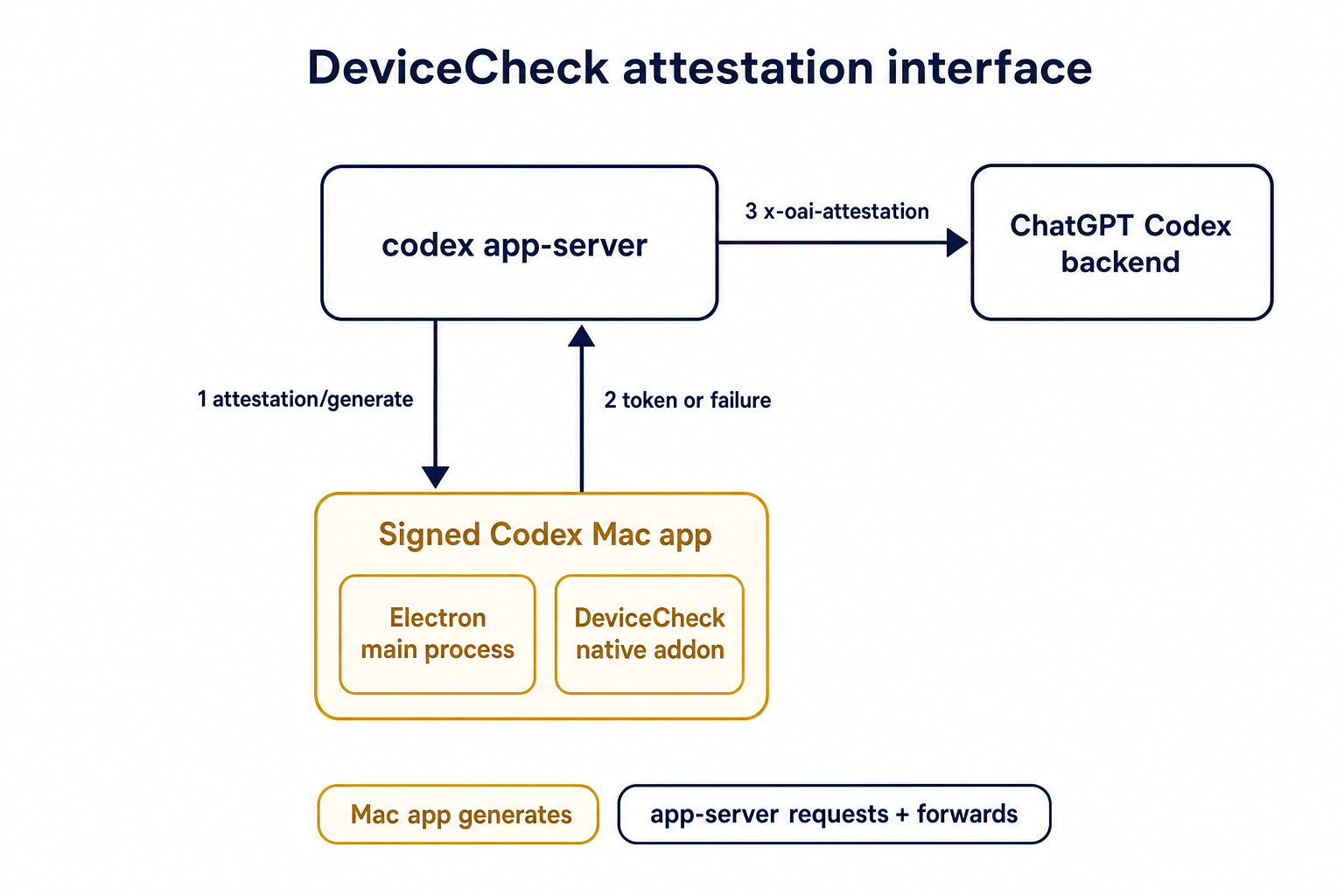
## Details
This PR teaches the Codex app-server runtime how to request and attach
an attestation token. It does not generate DeviceCheck tokens directly;
instead, it relies on the connected desktop app to advertise that it can
generate attestation and then asks that app for a fresh header value
when needed.
The flow is:
1. The Codex desktop app connects to app-server.
2. During `initialize`, the app can advertise that it supports
`requestAttestation`.
3. Before app-server calls selected ChatGPT Codex endpoints, it sends
the internal server request `attestation/generate` to the app.
4. app-server receives a pre-encoded header value back.
5. app-server forwards that value as `x-oai-attestation` on the scoped
outbound requests.
The code in this repo is mostly protocol and runtime plumbing: it adds
the app-server request/response shape, introduces an attestation
provider in core, wires that provider into Responses / compaction /
realtime setup paths, and covers the intended scoping with tests. The
signed macOS DeviceCheck generation remains owned by the desktop app PR.
## Related PR
- Codex desktop app implementation:
https://github.com/openai/openai/pull/878649
## Validation
<details>
<summary>Tests run</summary>
```sh
cargo test -p codex-app-server-protocol
cargo test -p codex-core attestation --lib
cargo test -p codex-app-server --lib attestation
```
Also ran:
```sh
just fix -p codex-core
just fix -p codex-app-server
just fix -p codex-app-server-protocol
just fmt
just write-app-server-schema
```
</details>
<details>
<summary>E2E DeviceCheck validation</summary>
First validated the signed desktop app boundary directly: launched a
packaged signed `Codex.app`, sent `attestation/generate`, decoded the
returned `v1.` attestation header, and validated the extracted
DeviceCheck token with `personal/jm/verify_devicecheck_token.py` using
bundle ID `com.openai.codex`. Apple returned `status_code: 200` and
`is_ok: true`.
Then ran the fuller app + app-server flow. The packaged `Codex.app`
launched a current-branch app-server via `CODEX_CLI_PATH`, and a local
MITM proxy intercepted outbound `chatgpt.com` traffic. The app-server
requested `attestation/generate` from the real Electron app process, and
the intercepted `/backend-api/codex/responses` traffic included
`x-oai-attestation` on both routes:
```text
GET /backend-api/codex/responses Upgrade: websocket x-oai-attestation: present
POST /backend-api/codex/responses Upgrade: none x-oai-attestation: present
```
The captured header decoded to a DeviceCheck token that also validated
with Apple for `com.openai.codex` (`status_code: 200`, `is_ok: true`,
team `2DC432GLL2`).
</details>
---------
Co-authored-by: Codex <noreply@openai.com>
## Why
Remote TUI resume uses the app-server websocket client. That client
inherited tungstenite's default `16 MiB` frame limit, so a large saved
session could make `thread/resume` return a single JSON-RPC response
frame that the client rejected before the TUI could deserialize or
render it.
Fixes#19837
## What Changed
- Configure the remote app-server websocket client with a bounded `128
MiB` max frame/message size.
- Preserve the concrete remote worker exit reason when completing
pending requests after a transport/read failure instead of replacing it
with a generic channel-closed error.
- Add a regression test that sends a single `>16 MiB` JSON-RPC response
frame and verifies the typed request succeeds.
Note: This isn't a perfect fix. It really just moves the limit to a much
larger value. I looked at a bunch of other potential fixes (both
server-side and client-side), and they all involved significant
complexity, had backward-compatibility impact, or impacted performance
of common use cases. This simple fix should address the vast majority of
remote use cases.
## Verification
I reproed the problem locally using a long rollout. Verified that fix
addresses connection drop.
Addresses #18860

Problem: Remote app-server clients could stop draining websocket events
when their bounded local event channel filled, leaving clients stuck on
stale in-progress turns after a disconnect.

Solution: Use an unbounded local event channel for the remote client so
the websocket reader can keep forwarding disconnect and progress events
instead of blocking or dropping them.

Why this is reasonable: This does not make the remote websocket itself
unbounded. The changed queue lives inside the remote client, between the
task that reads the remote websocket and the API consumer in the same
client process. Once an event has been received from the remote server,
preserving it is preferable to blocking websocket reads or dropping
disconnect/lifecycle events; network-level backpressure still happens at
the websocket boundary if the remote side outpaces the client.
## Why

A Mac Bazel CI run saw `remote_notifications_arrive_over_websocket` fail
during shutdown with `remote app-server shutdown channel is closed`
(https://app.buildbuddy.io/invocation/9dac05d6-ae20-40f9-b627-fca6e91cf127).
The remote websocket worker can legitimately finish while `shutdown()`
is waiting for the shutdown acknowledgement: after the test server sends
a notification and exits, the worker may deliver the required disconnect
event, observe that the caller has dropped the event receiver, and exit
before it sends the shutdown one-shot.

That state is already terminal cleanup, not a failed shutdown, so
callers should not see a `BrokenPipe` from the acknowledgement channel.

## What Changed

- Treat a closed remote shutdown acknowledgement as an already-exited
worker while still propagating websocket close errors when the worker
returns them.
- Added a deterministic regression test for the interleaving where the
shutdown command is received and the worker exits before replying.

## Verification

- `cargo test -p codex-app-server-client`
- New test:
`remote::tests::shutdown_tolerates_worker_exit_after_command_is_queued`
Addresses #17283

Problem: `codex --remote wss://...` could panic because
app-server-client did not install rustls' process-level crypto provider
before opening TLS websocket connections.

Solution: Add the existing rustls provider utility dependency and
install it before the remote websocket connect.
This is the part 1 of 2 PRs that will delete the `tui` /
`tui_app_server` split. This part simply deletes the existing `tui`
directory and marks the `tui_app_server` feature flag as removed. I left
the `tui_app_server` feature flag in place for now so its presence
doesn't result in an error. It is simply ignored.

Part 2 will rename the `tui_app_server` directory `tui`. I did this as
two parts to reduce visible code churn.
For app-server websocket auth, support the two server-side mechanisms
from
PR #14847:

- `--ws-auth capability-token --ws-token-file /abs/path`
- `--ws-auth signed-bearer-token --ws-shared-secret-file /abs/path`
  with optional `--ws-issuer`, `--ws-audience`, and
  `--ws-max-clock-skew-seconds`

On the client side, add interactive remote support via:

- `--remote ws://host:port` or `--remote wss://host:port`
- `--remote-auth-token-env <ENV_VAR>`

Codex reads the bearer token from the named environment variable and
sends it
as `Authorization: Bearer <token>` during the websocket handshake.
Remote auth
tokens are only allowed for `wss://` URLs or loopback `ws://` URLs.

Testing:
- tested both auth methods manually to confirm connection success and
rejection for both auth types
## TL;DR

When running codex with `-c features.tui_app_server=true` we see
corruption when streaming large amounts of data. This PR marks other
event types as _critical_ by making them _must-deliver_.

## Problem

When the TUI consumer falls behind the app-server event stream, the
bounded `mpsc` channel fills up and the forwarding layer drops events
via `try_send`. Previously only `TurnCompleted` was marked as
must-deliver. Streamed assistant text (`AgentMessageDelta`) and the
authoritative final item (`ItemCompleted`) were treated as droppable —
the same as ephemeral command output deltas. Because the TUI renders
markdown incrementally from these deltas, dropping any of them produces
permanently corrupted or incomplete paragraphs that persist for the rest
of the session.

## Mental model

The app-server event stream has two tiers of importance:

1. **Lossless (transcript + terminal):** Events that form the
authoritative record of what the assistant said or that signal turn
lifecycle transitions. Losing any of these corrupts the visible output
or leaves surfaces waiting forever. These are: `AgentMessageDelta`,
`PlanDelta`, `ReasoningSummaryTextDelta`, `ReasoningTextDelta`,
`ItemCompleted`, and `TurnCompleted`.

2. **Best-effort (everything else):** Ephemeral status events like
`CommandExecutionOutputDelta` and progress notifications. Dropping these
under load causes cosmetic gaps but no permanent corruption.

The forwarding layer uses `try_send` for best-effort events (dropping on
backpressure) and blocking `send().await` for lossless events (applying
back-pressure to the producer until the consumer catches up).

## Non-goals

- Eliminating backpressure entirely. The bounded queue is intentional;
this change only widens the set of events that survive it.
- Changing the event protocol or adding new notification types.
- Addressing root causes of consumer slowness (e.g. TUI render cost).

## Tradeoffs

Blocking on transcript events means a slow consumer can now stall the
producer for the duration of those events. This is acceptable because:
(a) the alternative is permanently broken output, which is worse; (b)
the consumer already had to keep up with `TurnCompleted` blocking sends;
and (c) transcript events arrive at model-output speed, not burst speed,
so sustained saturation is unlikely in practice.

## Architecture

Two parallel changes, one per transport:

- **In-process path** (`lib.rs`): The inline forwarding logic was
extracted into `forward_in_process_event`, a standalone async function
that encapsulates the lag-marker / must-deliver / try-send decision
tree. The worker loop now delegates to it. A new
`server_notification_requires_delivery` function (shared `pub(crate)`)
centralizes the notification classification.

- **Remote path** (`remote.rs`): The local `event_requires_delivery` now
delegates to the same shared `server_notification_requires_delivery`,
keeping both transports in sync.

## Observability

No new metrics or log lines. The existing `warn!` on event drops
continues to fire for best-effort events. Lossless events that block
will not produce a log line (they simply wait).

## Tests

- `event_requires_delivery_marks_transcript_and_terminal_events`: unit
test confirming the expanded classification covers `AgentMessageDelta`,
`ItemCompleted`, `TurnCompleted`, and excludes
`CommandExecutionOutputDelta` and `Lagged`.
-
`forward_in_process_event_preserves_transcript_notifications_under_backpressure`:
integration-style test that fills a capacity-1 channel, verifies a
best-effort event is dropped (skipped count increments), then sends
lossless transcript events and confirms they all arrive in order with
the correct lag marker preceding them.
- `remote_backpressure_preserves_transcript_notifications`: end-to-end
test over a real websocket that verifies the remote transport preserves
transcript events under the same backpressure scenario.
- `event_requires_delivery_marks_transcript_and_disconnect_events`
(remote): unit test confirming the remote-side classification covers
transcript events and `Disconnected`.

---------

Co-authored-by: Eric Traut <etraut@openai.com>
This PR completes the conversion of non-interactive `codex exec` to use
app server rather than directly using core events and methods.

### Summary
- move `codex-exec` off exec-owned `AuthManager` and `ThreadManager`
state
- route exec bootstrap, resume, and auth refresh through existing
app-server paths
- replace legacy `codex/event/*` decoding in exec with typed app-server
notification handling
- update human and JSONL exec output adapters to translate existing
app-server notifications only
- clean up "app server client" layer by eliminating support for legacy
notifications; this is no longer needed
- remove exposure of `authManager` and `threadManager` from "app server
client" layer

### Testing
- `exec` has pretty extensive unit and integration tests already, and
these all pass
- In addition, I asked Codex to put together a comprehensive manual set
of tests to cover all of the `codex exec` functionality (including
command-line options), and it successfully generated and ran these tests
This PR replicates the `tui` code directory and creates a temporary
parallel `tui_app_server` directory. It also implements a new feature
flag `tui_app_server` to select between the two tui implementations.

Once the new app-server-based TUI is stabilized, we'll delete the old
`tui` directory and feature flag.
Gabriel Peal ·
Eric Traut ·
Jiaming Zhang ·
Michael Bolin ·
Felipe Coury ·
