97 Commits

  • [codex] group blocking and postmerge CI workflows (#30146)
    ## Why
    
    It's hard to change the set of required jobs when they're managed in the
    GitHub UI, and when each workflow is responsible for choosing it's own
    scheduling it's easy to end up with skew between what we enforce on PRs
    vs. on main.
    
    ## What
    
    - add a `blocking-ci` caller workflow, triggered by pull requests and
    pushes to `main`, for Bazel, blob size, cargo-deny, Codespell,
    `repo-checks`, rust CI, and SDK CI
    - add an `always()` terminal job named `CI required` that fails unless
    every called workflow succeeds
    - add a `postmerge-ci` caller workflow for `rust-ci-full` and
    `v8-canary`, with a terminal `Postmerge CI results` job
    - centralize V8 relevance detection in `v8_canary_changes.py`; unrelated
    PR and postmerge runs execute metadata only and skip the expensive build
    matrices
    - leave `v8-canary` outside the blocking gate and leave the external
    `cla` check independent
    
    ## Rollout
    
    A repository admin must replace the existing required GitHub Actions
    contexts with `CI required` in the main-branch ruleset. Retain `cla` as
    a separate required check. Until that change is coordinated, this PR
    cannot satisfy the old standalone check names. In-flight PRs will need
    to be rebased after this lands.
  • ci: fail jobs that dirty the worktree (#29720)
    ## Why
    
    CI jobs should not silently leave tracked changes or untracked files in
    the repository worktree.
    
    ## What
    
    - Add a shared final worktree-cleanliness action to 19 checkout-bearing
    PR and main CI jobs.
    - Ignore the intentional SDK scratch directory and nested V8 checkout.
    - Pin Bazelisk in shared CI setup so `.bazelversion` remains
    authoritative, avoiding `MODULE.bazel.lock` deltas on Windows runners.
    - Leave `rust-ci-full` and release-only workflows unchanged.
    - Update `AGENTS.md` to discourage review bots from asking for
    `MODULE.bazel.lock` changes.
  • ci: restore custom Windows runner with hermetic LLVM 0.7.9 (#29143)
    The custom Windows argument-comment-lint job was temporarily moved to
    `windows-2022` in #28940 after hermetic LLVM source extraction failed on
    the newer runner. This takes the upstream extraction fix so the job can
    return to the intended custom runner.
    
    This upgrades `llvm` to `0.7.9` and `rules_cc` to `0.2.18`, refreshes
    the module lock, rebases the remaining Windows and custom libc++
    patches, drops the obsolete symlink-extraction workaround, and restores
    the `windows-x64` runner configuration.
    
    Validation:
    
    - Verified all LLVM patches apply cleanly against the `0.7.9` source.
    - Built `@llvm-project//compiler-rt:clang_rt.builtins.static`.
  • Pin Windows argument lint to Windows 2022 (#28940)
    ## What
    
    Run the Windows argument-comment-lint job on the `windows-2022` hosted
    runner instead of the custom Windows runner pool.
    
    ## Why
    
    The custom pool recently moved from the Visual Studio 2022 Windows image
    to `windows-2025-vs2026`. Since that migration, the job fails while
    Bazel materializes LLVM external repository sources, before the argument
    lint itself runs. The same failure appears across unrelated PRs.
    
    This narrow change tests GitHub’s recommended mitigation for workloads
    that still require the Visual Studio 2022 image:
    https://github.com/actions/runner-images/issues/14017
    
    ## How
    
    Use the standard `windows-2022` runner for only the Windows
    argument-comment-lint matrix entry. No product code or lint behavior
    changes.
  • ci: template custom runner names by repo (#27024)
    ## Why
    
    These workflows currently hard-code the `codex` runner group and custom
    runner labels. That makes the same workflow definitions less portable
    across repository copies or renamed repos, even though the runner fleet
    follows the repository name scheme. Template the runner identities from
    the repository name so `openai/codex` still resolves to the existing
    `codex-*` runners while other repos can use their own `<repo>-*` runner
    names.
    
    ## What Changed
    
    - Replaced custom runner `group` values such as `codex-runners` with
    `${{ github.event.repository.name }}-runners`.
    - Replaced custom runner labels such as `codex-linux-x64` and
    `codex-windows-arm64` with `${{ github.event.repository.name }}-...`.
    - Covered direct `runs-on` objects, matrix `runs_on` entries, reusable
    workflow runner inputs, and release runner labels.
    
    ## Verification
    
    - Parsed all `.github/workflows/*.yml` files as YAML with Ruby.
    - Searched `.github/workflows` to confirm no hardcoded runner-field
    `codex-runners` or `codex-*` labels remain.
  • ci: use bazel environment for BuildBuddy secret (#26895)
    ## Why
    
    `BUILDBUDDY_API_KEY` now lives in the `bazel` GitHub Actions environment
    as an environment secret. Jobs that need BuildBuddy credentials must opt
    into that environment so `${{ secrets.BUILDBUDDY_API_KEY }}` resolves
    from the protected environment secret instead of relying on an unscoped
    repository/organization secret.
    
    This follows the same environment-secret migration pattern as #26466.
    
    ## What Changed
    
    - Attach each workflow job that reads `BUILDBUDDY_API_KEY` to the
    `bazel` environment.
    - Set `deployment: false` on those job-level environment blocks.
    
    `deployment: false` lets the job enter the `bazel` environment to access
    its environment secrets without creating GitHub deployment records for
    these CI jobs. That keeps the environment as a secret/access-control
    boundary without making ordinary Bazel CI runs look like deploys.
    
    ## Validation
    
    - Parsed the modified workflow YAML files with Ruby's YAML parser.
    - Checked the modified workflow files for trailing whitespace.
  • [codex] Use git CLI for Cargo fetches across Rust workflows (#25775)
    ## Why
    Cargo's libgit2 transport has intermittently failed while fetching git
    dependencies with nested submodules.
    [#25644](https://github.com/openai/codex/pull/25644) applied
    `CARGO_NET_GIT_FETCH_WITH_CLI=true` to the main Rust release build after
    macOS SecureTransport/libgit2 failures while cloning `libwebrtc`'s
    nested `libyuv` submodule. Similar flakes can affect other Cargo-bearing
    Rust jobs.
    
    ## What changed
    Configure `CARGO_NET_GIT_FETCH_WITH_CLI=true` at workflow scope for the
    remaining Cargo-bearing Rust workflows:
    
    - fast Rust CI and `cargo-deny`
    - reusable Windows and argument-comment-lint release workflows
    - `rusty-v8-release` and `v8-canary` Cargo builds and smoke tests
    
    The full Rust CI, reusable nextest workflow, and primary Rust release
    build already had the override. Bazel-only workflows are unchanged
    because they use a different dependency fetch path.
    
    ## Validation
    - Parsed all `.github/workflows/*.yml` files as YAML.
    - Scanned Cargo-bearing workflows to confirm they configure
    `CARGO_NET_GIT_FETCH_WITH_CLI`.
  • Uprev Rust toolchain pins to 1.95.0 (#24684)
    ## Summary
    - Bump the workspace Rust toolchain from `1.93.0` to `1.95.0` across
    Cargo, Bazel, CI, release workflows, devcontainers, and the Codex
    environment config.
    - Refresh `MODULE.bazel.lock` so the Bazel Rust toolchain artifacts
    match the new version.
    - Leave purpose-specific toolchains unchanged, including the
    `argument-comment-lint` nightly and the upstream `rusty_v8` `1.91.0`
    build pin.
    - Includes fixes for new lints from `just fix` and a few codex-authored
    fixes for lints without a suggestion.
  • [codex] Add image re-encoding benchmarks (#23935)
    ## Summary
    - add Divan benchmarks for prompt image re-encoding paths
    - wire the image benchmark smoke test into Rust CI workflows
    
    ## Why
    Image prompt handling includes re-encoding work that benefits from
    repeatable benchmark coverage so changes can be measured in CI and
    locally.
    
    This already helped identify a potential regression from changing compiler flags.
    
    ## Impact
    Developers can run and compare the new image re-encoding benchmarks, and
    CI exercises the benchmark target via the Rust benchmark smoke test.
  • ci: check out PR head commits in workflows (#21835)
    ## Why
    
    PR CI should test the exact commit that was pushed to the PR branch. By
    default, GitHub's `pull_request` event checks out a synthetic merge
    commit from `refs/pull/<number>/merge`, so the tested tree can include
    an implicit merge with the current base branch instead of matching the
    pushed head SHA.
    
    Using the PR head SHA makes each check result correspond to a concrete
    commit the author submitted. This also behaves better for stacked PR
    workflows, including Sapling stacks and other Git stack tooling: a
    middle PR's head commit already contains the lower stack changes in its
    tree, without pulling in commits above it or GitHub's temporary merge
    ref.
    
    ## What Changed
    
    - Set every `actions/checkout` in `pull_request` workflows under
    `.github/workflows` to use `github.event.pull_request.head.sha` on PR
    events and `github.sha` otherwise.
    - Updated `blob-size-policy` to compare
    `github.event.pull_request.base.sha` and
    `github.event.pull_request.head.sha`, since it no longer checks out
    GitHub's merge commit where `HEAD^1`/`HEAD^2` represented the PR range.
    
    ## Verification
    
    - Parsed the edited workflow YAML files with Ruby.
    - Checked that every checkout block in the `pull_request` workflows has
    the PR-head `ref`.
  • Enable --deny-warnings for cargo shear (#21616)
    ## Summary
    
    In https://github.com/openai/codex/pull/21584, we disabled doctests for
    crates that lack any doctests. We can enforce that property via `cargo
    shear --deny-warnings`: crates that lack doctests will be flagged if
    doctests are enabled, and crates with doctests will be flagged if
    doctests are disabled.
    
    A few additional notes:
    
    - By adding `--deny-warnings`, `cargo shear` also flagged a number of
    modules that were not reachable at all. Some of those have been removed.
    - This PR removes a usage of `windows_modules!` (since `cargo shear` and
    `rustfmt` couldn't see through it) in favor of simple `#[cfg(target_os =
    "windows")]` macros. As a consequence, many of these files exhibit churn
    in this PR, since they weren't being formatted by `rustfmt` at all on
    main.
    - Again, to make the code more analyzable, this PR also removes some
    usages of `#[path = "cwd_junction.rs"]` in favor of a more standard
    module structure. The bin sidecar structure is still retained, but,
    e.g., `windows-sandbox-rs/src/bin/command_runner.rs‎` was moved to
    `windows-sandbox-rs/src/bin/command_runner/main.rs`, and so on.
    
    ---------
    
    Co-authored-by: Codex <noreply@openai.com>
  • [codex] Address some more GHA hygiene issues (#21622)
    This does two things:
    
    - We use `persist-credentials: false` everywhere now. This is
    unfortunately not the default in GitHub Actions, but it prevents
    `actions/checkout` from dropping `secrets.GITHUB_TOKEN` onto disk.
    - We interpose (some) template expansions through environment variables.
    I've limited this to contexts that have non-fixed values; contexts that
    are fixed (like `*.result`) are not dangerous to expand directly inline
    (but maybe we should clean those up in the future for consistency
    anyways).
    
    This is a medium-risk change in terms of CI breakage: I did a scan for
    usage of `git push` and other commands that implicitly use the persisted
    credential, but couldn't find any. Even still, some implicit usages of
    the persisted credentials may be lurking. Please ping ww@ if any issues
    arise.
  • [codex] Fully qualify hash-pins in GitHub Actions (#21436)
    This builds on top of https://github.com/openai/codex/pull/15828 by
    ensuring that hash-pinned actions with version comments are fully
    qualified, rather than referencing floating/mutable comments like "v7".
    This makes actions management tools behave more consistently.
    
    This shouldn't break anything, since it's comment only. But if it does,
    ping ww@ 🙂
  • Upgrade cargo-shear to 1.11.2 (#21547)
    ## Summary
    
    Catches a few additional dependencies (`sha2`, `url`) that should be in
    `dev-dependencies`.
  • test: set Rust test thread stack size (#19067)
    ## Summary
    
    Set `RUST_MIN_STACK=8388608` for Rust test entry points so
    libtest-spawned test threads get an 8 MiB stack.
    
    The Windows BuildBuddy failure on #18893 showed
    `//codex-rs/tui:tui-unit-tests` exiting with a stack overflow in a
    `#[tokio::test]` even though later test binaries in the shard printed
    successful summaries. Default `#[tokio::test]` uses a current-thread
    Tokio runtime, which means the async test body is driven on libtest's
    std-spawned test thread. Increasing the test thread stack addresses that
    failure mode directly.
    
    To date, we have been fixing these stack-pressure problems with
    localized future-size reductions, such as #13429, and by adding
    `Box::pin()` in specific async wrapper chains. This gives us a baseline
    test-runner stack size instead of continuing to patch individual tests
    only after CI finds another large async future.
    
    ## What changed
    
    - Added `common --test_env=RUST_MIN_STACK=8388608` in `.bazelrc` so
    Bazel test actions receive the env var through Bazel's cache-keyed test
    environment path.
    - Set the same `RUST_MIN_STACK` value for Cargo/nextest CI entry points
    and `just test`.
    - Annotated the existing Windows Bazel linker stack reserve as 8 MiB so
    it stays aligned with the libtest thread stack size.
    
    ## Testing
    
    - `just --list`
    - parsed `.github/workflows/rust-ci.yml` and
    `.github/workflows/rust-ci-full.yml` with Ruby's YAML loader
    - compared `bazel aquery` `TestRunner` action keys before/after explicit
    `--test_env=RUST_MIN_STACK=...` and after moving the Bazel env to
    `.bazelrc`
    - `bazel test //codex-rs/tui:tui-unit-tests --test_output=errors`
    - failed locally on the existing sandbox-specific status snapshot
    permission mismatch, but loaded the Starlark changes and ran the TUI
    test shards
  • ci: keep argument comment lint checks materialized (#18926)
    ## Why
    
    The fast `rust-ci` workflow decides whether to run the cross-platform
    `argument-comment-lint` job based on changed paths. PRs that touch
    Rust-adjacent Bazel wrapper files, such as `defs.bzl` or
    `workspace_root_test_launcher.*.tpl`, can change how Rust tests and lint
    targets behave without changing any `.rs` files.
    
    When that detector returned false, GitHub skipped the matrix job before
    expanding it. That produced a single skipped check named `Argument
    comment lint - ${{ matrix.name }}` instead of the Linux, macOS, and
    Windows check names that branch protection expects, leaving the PR
    unable to go green when those matrix checks are required.
    
    ## What Changed
    
    - Treat root Bazel wrapper files as `argument-comment-lint` relevant
    changes.
    - Keep the `argument_comment_lint_prebuilt` matrix job materialized for
    every PR so the per-platform check names always exist.
    - Add a single gate step that decides whether the real lint work should
    run.
    - Move the checkout-adjacent Bazel setup and OS-specific lint commands
    into `.github/actions/run-argument-comment-lint/action.yml` so the
    workflow does not repeat the same path-detection condition on each step.
    
    ## Verification
    
    - Parsed `.github/workflows/rust-ci.yml` and
    `.github/actions/run-argument-comment-lint/action.yml` with Python YAML
    loading.
    - Simulated the workflow path-matching shell conditions for the root
    Bazel wrapper files and confirmed they set `argument_comment_lint=true`.
  • fix: pin inputs (#17471)
    ## Summary
    - Pin Rust git patch dependencies to immutable revisions and make
    cargo-deny reject unknown git and registry sources unless explicitly
    allowlisted.
    - Add checked-in SHA-256 coverage for the current rusty_v8 release
    assets, wire those hashes into Bazel, and verify CI override downloads
    before use.
    - Add rusty_v8 MODULE.bazel update/check tooling plus a Bazel CI guard
    so future V8 bumps cannot drift from the checked-in checksum manifest.
    - Pin release/lint cargo installs and all external GitHub Actions refs
    to immutable inputs.
    
    ## Future V8 bump flow
    Run these after updating the resolved `v8` crate version and checksum
    manifest:
    
    ```bash
    python3 .github/scripts/rusty_v8_bazel.py update-module-bazel
    python3 .github/scripts/rusty_v8_bazel.py check-module-bazel
    ```
    
    The update command rewrites the matching `rusty_v8_<crate_version>`
    `http_file` SHA-256 values in `MODULE.bazel` from
    `third_party/v8/rusty_v8_<crate_version>.sha256`. The check command is
    also wired into Bazel CI to block drift.
    
    ## Notes
    - This intentionally excludes RustSec dependency upgrades and
    bubblewrap-related changes per request.
    - The branch was rebased onto the latest origin/main before opening the
    PR.
    
    ## Validation
    - cargo fetch --locked
    - cargo deny check advisories
    - cargo deny check
    - cargo deny check sources
    - python3 .github/scripts/rusty_v8_bazel.py check-module-bazel
    - python3 .github/scripts/rusty_v8_bazel.py update-module-bazel
    - python3 -m unittest discover -s .github/scripts -p
    'test_rusty_v8_bazel.py'
    - python3 -m py_compile .github/scripts/rusty_v8_bazel.py
    .github/scripts/rusty_v8_module_bazel.py
    .github/scripts/test_rusty_v8_bazel.py
    - repo-wide GitHub Actions `uses:` audit: all external action refs are
    pinned to 40-character SHAs
    - yq eval on touched workflows and local actions
    - git diff --check
    - just bazel-lock-check
    
    ## Hash verification
    - Confirmed `MODULE.bazel` hashes match
    `third_party/v8/rusty_v8_146_4_0.sha256`.
    - Confirmed GitHub release asset digests for denoland/rusty_v8
    `v146.4.0` and openai/codex `rusty-v8-v146.4.0` match the checked-in
    hashes.
    - Streamed and SHA-256 hashed all 10 `MODULE.bazel` rusty_v8 asset URLs
    locally; every downloaded byte stream matched both `MODULE.bazel` and
    the checked-in manifest.
    
    ## Pin verification
    - Confirmed signing-action pins match the peeled commits for their tag
    comments: `sigstore/cosign-installer@v3.7.0`, `azure/login@v2`, and
    `azure/trusted-signing-action@v0`.
    - Pinned the remaining tag-based action refs in Bazel CI/setup:
    `actions/setup-node@v6`, `facebook/install-dotslash@v2`,
    `bazelbuild/setup-bazelisk@v3`, and `actions/cache/restore@v5`.
    - Normalized all `bazelbuild/setup-bazelisk@v3` refs to the peeled
    commit behind the annotated tag.
    - Audited Cargo git dependencies: every manifest git dependency uses
    `rev` only, every `Cargo.lock` git source has `?rev=<sha>#<same-sha>`,
    and `cargo deny check sources` passes with `required-git-spec = "rev"`.
    - Shallow-fetched each distinct git dependency repo at its pinned SHA
    and verified Git reports each object as a commit.
  • ci: run Windows argument-comment-lint via native Bazel (#16120)
    ## Why
    
    Follow-up to #16106.
    
    `argument-comment-lint` already runs as a native Bazel aspect on Linux
    and macOS, but Windows is still the long pole in `rust-ci`. To move
    Windows onto the same native Bazel lane, the toolchain split has to let
    exec-side helper binaries build in an MSVC environment while still
    linting repo crates as `windows-gnullvm`.
    
    Pushing the Windows lane onto the native Bazel path exposed a second
    round of Windows-only issues in the mixed exec-toolchain plumbing after
    the initial wrapper/target fixes landed.
    
    ## What Changed
    
    - keep the Windows lint lanes on the native Bazel/aspect path in
    `rust-ci.yml` and `rust-ci-full.yml`
    - add a dedicated `local_windows_msvc` platform for exec-side helper
    binaries while keeping `local_windows` as the `windows-gnullvm` target
    platform
    - patch `rules_rust` so `repository_set(...)` preserves explicit
    exec-platform constraints for the generated toolchains, keep the
    Windows-specific bootstrap/direct-link fixes needed for the nightly lint
    driver, and expose exec-side `rustc-dev` `.rlib`s to the MSVC sysroot
    - register the custom Windows nightly toolchain set with MSVC exec
    constraints while still exposing both `x86_64-pc-windows-msvc` and
    `x86_64-pc-windows-gnullvm` targets
    - enable `dev_components` on the custom Windows nightly repository set
    so the MSVC exec helper toolchain actually downloads the
    compiler-internal crates that `clippy_utils` needs
    - teach `run-argument-comment-lint-bazel.sh` to enumerate concrete
    Windows Rust rules, normalize the resulting labels, and skip explicitly
    requested incompatible targets instead of failing before the lint run
    starts
    - patch `rules_rust` build-script env propagation so exec-side
    `windows-msvc` helper crates drop forwarded MinGW include and linker
    search paths as whole flag/path pairs instead of emitting malformed
    `CFLAGS`, `CXXFLAGS`, and `LDFLAGS`
    - export the Windows VS/MSVC SDK environment in `setup-bazel-ci` and
    pass the relevant variables through `run-bazel-ci.sh` via `--action_env`
    / `--host_action_env` so Bazel build scripts can see the MSVC and UCRT
    headers on native Windows runs
    - add inline comments to the Windows `setup-bazel-ci` MSVC environment
    export step so it is easier to audit how `vswhere`, `VsDevCmd.bat`, and
    the filtered `GITHUB_ENV` export fit together
    - patch `aws-lc-sys` to skip its standalone `memcmp` probe under Bazel
    `windows-msvc` build-script environments, which avoids a Windows-native
    toolchain mismatch that blocked the lint lane before it reached the
    aspect execution
    - patch `aws-lc-sys` to prefer its bundled `prebuilt-nasm` objects for
    Bazel `windows-msvc` build-script runs, which avoids missing
    `generated-src/win-x86_64/*.asm` runfiles in the exec-side helper
    toolchain
    - annotate the Linux test-only callsites in `codex-rs/linux-sandbox` and
    `codex-rs/core` that the wider native lint coverage surfaced
    
    ## Patches
    
    This PR introduces a large patch stack because the Windows Bazel lint
    lane currently depends on behavior that upstream dependencies do not
    provide out of the box in the mixed `windows-gnullvm` target /
    `windows-msvc` exec-toolchain setup.
    
    - Most of the `rules_rust` patches look like upstream candidates rather
    than OpenAI-only policy. Preserving explicit exec-platform constraints,
    forwarding the right MSVC/UCRT environment into exec-side build scripts,
    exposing exec-side `rustc-dev` artifacts, and keeping the Windows
    bootstrap/linker behavior coherent all look like fixes to the Bazel/Rust
    integration layer itself.
    - The two `aws-lc-sys` patches are more tactical. They special-case
    Bazel `windows-msvc` build-script environments to avoid a `memcmp` probe
    mismatch and missing NASM runfiles. Those may be harder to upstream
    as-is because they rely on Bazel-specific detection instead of a general
    Cargo/build-script contract.
    - Short term, carrying these patches in-tree is reasonable because they
    unblock a real CI lane and are still narrow enough to audit. Long term,
    the goal should not be to keep growing a permanent local fork of either
    dependency.
    - My current expectation is that the `rules_rust` patches are less
    controversial and should be broken out into focused upstream proposals,
    while the `aws-lc-sys` patches are more likely to be temporary escape
    hatches unless that crate wants a more general hook for hermetic build
    systems.
    
    Suggested follow-up plan:
    
    1. Split the `rules_rust` deltas into upstream-sized PRs or issues with
    minimized repros.
    2. Revisit the `aws-lc-sys` patches during the next dependency bump and
    see whether they can be replaced by an upstream fix, a crate upgrade, or
    a cleaner opt-in mechanism.
    3. Treat each dependency update as a chance to delete patches one by one
    so the local patch set only contains still-needed deltas.
    
    ## Verification
    
    - `./.github/scripts/run-argument-comment-lint-bazel.sh
    --config=argument-comment-lint --keep_going`
    - `RUNNER_OS=Windows
    ./.github/scripts/run-argument-comment-lint-bazel.sh --nobuild
    --config=argument-comment-lint --platforms=//:local_windows
    --keep_going`
    - `cargo test -p codex-linux-sandbox`
    - `cargo test -p codex-core shell_snapshot_tests`
    - `just argument-comment-lint`
    
    ## References
    
    - #16106
  • fix: close Bazel argument-comment-lint CI gaps (#16253)
    ## Why
    
    The Bazel-backed `argument-comment-lint` CI path had two gaps:
    
    - Bazel wildcard target expansion skipped inline unit-test crates from
    `src/` modules because the generated `*-unit-tests-bin` `rust_test`
    targets are tagged `manual`.
    - `argument-comment-mismatch` was still only a warning in the Bazel and
    packaged-wrapper entrypoints, so a typoed `/*param_name*/` comment could
    still pass CI even when the lint detected it.
    
    That left CI blind to real linux-sandbox examples, including the missing
    `/*local_port*/` comment in
    `codex-rs/linux-sandbox/src/proxy_routing.rs` and typoed argument
    comments in `codex-rs/linux-sandbox/src/landlock.rs`.
    
    ## What Changed
    
    - Added `tools/argument-comment-lint/list-bazel-targets.sh` so Bazel
    lint runs cover `//codex-rs/...` plus the manual `rust_test`
    `*-unit-tests-bin` targets.
    - Updated `just argument-comment-lint`, `rust-ci.yml`, and
    `rust-ci-full.yml` to use that helper.
    - Promoted both `argument-comment-mismatch` and
    `uncommented-anonymous-literal-argument` to errors in every strict
    entrypoint:
      - `tools/argument-comment-lint/lint_aspect.bzl`
      - `tools/argument-comment-lint/src/bin/argument-comment-lint.rs`
      - `tools/argument-comment-lint/wrapper_common.py`
    - Added wrapper/bin coverage for the stricter lint flags and documented
    the behavior in `tools/argument-comment-lint/README.md`.
    - Fixed the now-covered callsites in
    `codex-rs/linux-sandbox/src/proxy_routing.rs`,
    `codex-rs/linux-sandbox/src/landlock.rs`, and
    `codex-rs/core/src/shell_snapshot_tests.rs`.
    
    This keeps the Bazel target expansion narrow while making the Bazel and
    prebuilt-linter paths enforce the same strict lint set.
    
    ## Verification
    
    - `python3 -m unittest discover -s tools/argument-comment-lint -p
    'test_*.py'`
    - `cargo +nightly-2025-09-18 test --manifest-path
    tools/argument-comment-lint/Cargo.toml`
    - `just argument-comment-lint`
  • build: migrate argument-comment-lint to a native Bazel aspect (#16106)
    ## Why
    
    `argument-comment-lint` had become a PR bottleneck because the repo-wide
    lane was still effectively running a `cargo dylint`-style flow across
    the workspace instead of reusing Bazel's Rust dependency graph. That
    kept the lint enforced, but it threw away the main benefit of moving
    this job under Bazel in the first place: metadata reuse and cacheable
    per-target analysis in the same shape as Clippy.
    
    This change moves the repo-wide lint onto a native Bazel Rust aspect so
    Linux and macOS can lint `codex-rs` without rebuilding the world
    crate-by-crate through the wrapper path.
    
    ## What Changed
    
    - add a nightly Rust toolchain with `rustc-dev` for Bazel and a
    dedicated crate-universe repo for `tools/argument-comment-lint`
    - add `tools/argument-comment-lint/driver.rs` and
    `tools/argument-comment-lint/lint_aspect.bzl` so Bazel can run the lint
    as a custom `rustc_driver`
    - switch repo-wide `just argument-comment-lint` and the Linux/macOS
    `rust-ci` lanes to `bazel build --config=argument-comment-lint
    //codex-rs/...`
    - keep the Python/DotSlash wrappers as the package-scoped fallback path
    and as the current Windows CI path
    - gate the Dylint entrypoint behind a `bazel_native` feature so the
    Bazel-native library avoids the `dylint_*` packaging stack
    - update the aspect runtime environment so the driver can locate
    `rustc_driver` correctly under remote execution
    - keep the dedicated `tools/argument-comment-lint` package tests and
    wrapper unit tests in CI so the source and packaged entrypoints remain
    covered
    
    ## Verification
    
    - `python3 -m unittest discover -s tools/argument-comment-lint -p
    'test_*.py'`
    - `cargo test` in `tools/argument-comment-lint`
    - `bazel build
    //tools/argument-comment-lint:argument-comment-lint-driver
    --@rules_rust//rust/toolchain/channel=nightly`
    - `bazel build --config=argument-comment-lint
    //codex-rs/utils/path-utils:all`
    - `bazel build --config=argument-comment-lint
    //codex-rs/rollout:rollout`


    ---
    [//]: # (BEGIN SAPLING FOOTER)
    Stack created with [Sapling](https://sapling-scm.com). Best reviewed
    with [ReviewStack](https://reviewstack.dev/openai/codex/pull/16106).
    * #16120
    * __->__ #16106
  • ci: split fast PR Rust CI from full post-merge Cargo CI (#16072)
    ## Summary
    
    Split the old all-in-one `rust-ci.yml` into:
    
    - a PR-time Cargo workflow in `rust-ci.yml`
    - a full post-merge Cargo workflow in `rust-ci-full.yml`
    
    This keeps the PR path focused on fast Cargo-native hygiene plus the
    Bazel `build` / `test` / `clippy` coverage in `bazel.yml`, while moving
    the heavyweight Cargo-native matrix to `main`.
    
    ## Why
    
    `bazel.yml` is now the main Rust verification workflow for pull
    requests. It already covers the Bazel build, test, and clippy signal we
    care about pre-merge, and it also runs on pushes to `main` to re-verify
    the merged tree and help keep the BuildBuddy caches warm.
    
    What was still missing was a clean split for the Cargo-native checks
    that Bazel does not replace yet. The old `rust-ci.yml` mixed together:
    
    - fast hygiene checks such as `cargo fmt --check` and `cargo shear`
    - `argument-comment-lint`
    - the full Cargo clippy / nextest / release-build matrix
    
    That made every PR pay for the full Cargo matrix even though most of
    that coverage is better treated as post-merge verification. The goal of
    this change is to leave PRs with the checks we still want before merge,
    while moving the heavier Cargo-native matrix off the review path.
    
    ## What Changed
    
    - Renamed the old heavyweight workflow to `rust-ci-full.yml` and limited
    it to `push` on `main` plus `workflow_dispatch`.
    - Added a new PR-only `rust-ci.yml` that runs:
      - changed-path detection
      - `cargo fmt --check`
      - `cargo shear`
      - `argument-comment-lint` on Linux, macOS, and Windows
    - `tools/argument-comment-lint` package tests when the lint itself or
    its workflow wiring changes
    - Kept the PR workflow's gatherer as the single required Cargo-native
    status so branch protection can stay simple.
    - Added `.github/workflows/README.md` to document the intended split
    between `bazel.yml`, `rust-ci.yml`, and `rust-ci-full.yml`.
    - Preserved the recent Windows `argument-comment-lint` behavior from
    `e02fd6e1d3` in `rust-ci-full.yml`, and mirrored cross-platform lint
    coverage into the PR workflow.
    
    A few details are deliberate:
    
    - The PR workflow still keeps the Linux lint lane on the
    default-targets-only invocation for now, while macOS and Windows use the
    broader released-linter path.
    - This PR does not change `bazel.yml`; it changes the Cargo-native
    workflow around the existing Bazel PR path.
    
    ## Testing
    
    - Rebasing this change onto `main` after `e02fd6e1d3`
    - `ruby -e 'require "yaml"; %w[.github/workflows/rust-ci.yml
    .github/workflows/rust-ci-full.yml .github/workflows/bazel.yml].each {
    |f| YAML.load_file(f) }'`
  • fix: clean up remaining Windows argument-comment-lint violations (#16071)
    ## Why
    
    The initial `argument-comment-lint` rollout left Windows on
    default-target coverage because there were still Windows-only callsites
    failing under `--all-targets`. This follow-up cleans up those remaining
    Windows-specific violations so the Windows CI lane can enforce the same
    stricter coverage, leaving Linux as the remaining platform-specific
    follow-up.
    
    ## What changed
    
    - switched the Windows `rust-ci` argument-comment-lint step back to the
    default wrapper invocation so it runs full-target coverage again
    - added the required `/*param_name*/` annotations at Windows-gated
    literal callsites in:
      - `codex-rs/windows-sandbox-rs/src/lib.rs`
      - `codex-rs/windows-sandbox-rs/src/elevated_impl.rs`
      - `codex-rs/tui_app_server/src/multi_agents.rs`
      - `codex-rs/network-proxy/src/proxy.rs`
    
    ## Validation
    
    - Windows `argument comment lint` CI on this PR
  • refactor: rewrite argument-comment lint wrappers in Python (#16063)
    ## Why
    
    The `argument-comment-lint` entrypoints had grown into two shell
    wrappers with duplicated parsing, environment setup, and Cargo
    forwarding logic. The recent `--` separator regression was a good
    example of the problem: the behavior was subtle, easy to break, and hard
    to verify.
    
    This change rewrites those wrappers in Python so the control flow is
    easier to follow, the shared behavior lives in one place, and the tricky
    argument/defaulting paths have direct test coverage.
    
    ## What changed
    
    - replaced `tools/argument-comment-lint/run.sh` and
    `tools/argument-comment-lint/run-prebuilt-linter.sh` with Python
    entrypoints: `run.py` and `run-prebuilt-linter.py`
    - moved shared wrapper behavior into
    `tools/argument-comment-lint/wrapper_common.py`, including:
      - splitting lint args from forwarded Cargo args after `--`
    - defaulting repo runs to `--manifest-path codex-rs/Cargo.toml
    --workspace --no-deps`
    - defaulting non-`--fix` runs to `--all-targets` unless the caller
    explicitly narrows the target set
      - setting repo defaults for `DYLINT_RUSTFLAGS` and `CARGO_INCREMENTAL`
    - kept the prebuilt wrapper thin: it still just resolves the packaged
    DotSlash entrypoint, keeps `rustup` shims first on `PATH`, infers
    `RUSTUP_HOME` when needed, and then launches the packaged `cargo-dylint`
    path
    - updated `justfile`, `rust-ci.yml`, and
    `tools/argument-comment-lint/README.md` to use the Python entrypoints
    - updated `rust-ci` so the package job runs Python syntax checks plus
    the new wrapper unit tests, and the OS-specific lint jobs invoke the
    wrappers through an explicit Python interpreter
    
    This is a follow-up to #16054: it keeps the current lint semantics while
    making the wrapper logic maintainable enough to iterate on safely.
    
    ## Validation
    
    - `python3 -m py_compile tools/argument-comment-lint/wrapper_common.py
    tools/argument-comment-lint/run.py
    tools/argument-comment-lint/run-prebuilt-linter.py
    tools/argument-comment-lint/test_wrapper_common.py`
    - `python3 -m unittest discover -s tools/argument-comment-lint -p
    'test_*.py'`
    - `python3 ./tools/argument-comment-lint/run-prebuilt-linter.py -p
    codex-terminal-detection -- --lib`
    - `python3 ./tools/argument-comment-lint/run.py -p
    codex-terminal-detection -- --lib`
  • chore: clean up argument-comment lint and roll out all-target CI on macOS (#16054)
    ## Why
    
    `argument-comment-lint` was green in CI even though the repo still had
    many uncommented literal arguments. The main gap was target coverage:
    the repo wrapper did not force Cargo to inspect test-only call sites, so
    examples like the `latest_session_lookup_params(true, ...)` tests in
    `codex-rs/tui_app_server/src/lib.rs` never entered the blocking CI path.
    
    This change cleans up the existing backlog, makes the default repo lint
    path cover all Cargo targets, and starts rolling that stricter CI
    enforcement out on the platform where it is currently validated.
    
    ## What changed
    
    - mechanically fixed existing `argument-comment-lint` violations across
    the `codex-rs` workspace, including tests, examples, and benches
    - updated `tools/argument-comment-lint/run-prebuilt-linter.sh` and
    `tools/argument-comment-lint/run.sh` so non-`--fix` runs default to
    `--all-targets` unless the caller explicitly narrows the target set
    - fixed both wrappers so forwarded cargo arguments after `--` are
    preserved with a single separator
    - documented the new default behavior in
    `tools/argument-comment-lint/README.md`
    - updated `rust-ci` so the macOS lint lane keeps the plain wrapper
    invocation and therefore enforces `--all-targets`, while Linux and
    Windows temporarily pass `-- --lib --bins`
    
    That temporary CI split keeps the stricter all-targets check where it is
    already cleaned up, while leaving room to finish the remaining Linux-
    and Windows-specific target-gated cleanup before enabling
    `--all-targets` on those runners. The Linux and Windows failures on the
    intermediate revision were caused by the wrapper forwarding bug, not by
    additional lint findings in those lanes.
    
    ## Validation
    
    - `bash -n tools/argument-comment-lint/run.sh`
    - `bash -n tools/argument-comment-lint/run-prebuilt-linter.sh`
    - shell-level wrapper forwarding check for `-- --lib --bins`
    - shell-level wrapper forwarding check for `-- --tests`
    - `just argument-comment-lint`
    - `cargo test` in `tools/argument-comment-lint`
    - `cargo test -p codex-terminal-detection`
    
    ## Follow-up
    
    - Clean up remaining Linux-only target-gated callsites, then switch the
    Linux lint lane back to the plain wrapper invocation.
    - Clean up remaining Windows-only target-gated callsites, then switch
    the Windows lint lane back to the plain wrapper invocation.
  • [codex] Pin GitHub Actions workflow references (#15828)
    Pin floating external GitHub Actions workflow refs to immutable SHAs.
    
    Why are we doing this? Please see the rationale doc:
    https://docs.google.com/document/d/1qOURCNx2zszQ0uWx7Fj5ERu4jpiYjxLVWBWgKa2wTsA/edit?tab=t.0
    
    Did this break you? Please roll back and let hintz@ know
  • fix: increase timeout for rust-ci to 45 minutes for now (#15948)
    https://github.com/openai/codex/pull/15478 raised the timeout to 35
    minutes for `windows-arm64` only, though I just hit 35 minutes on
    https://github.com/openai/codex/actions/runs/23628986591/job/68826740108?pr=15944,
    so let's just increase it to 45 minutes. As noted, I'm hoping that we
    can bring it back down once we no longer have two copies of the `tui`
    crate.
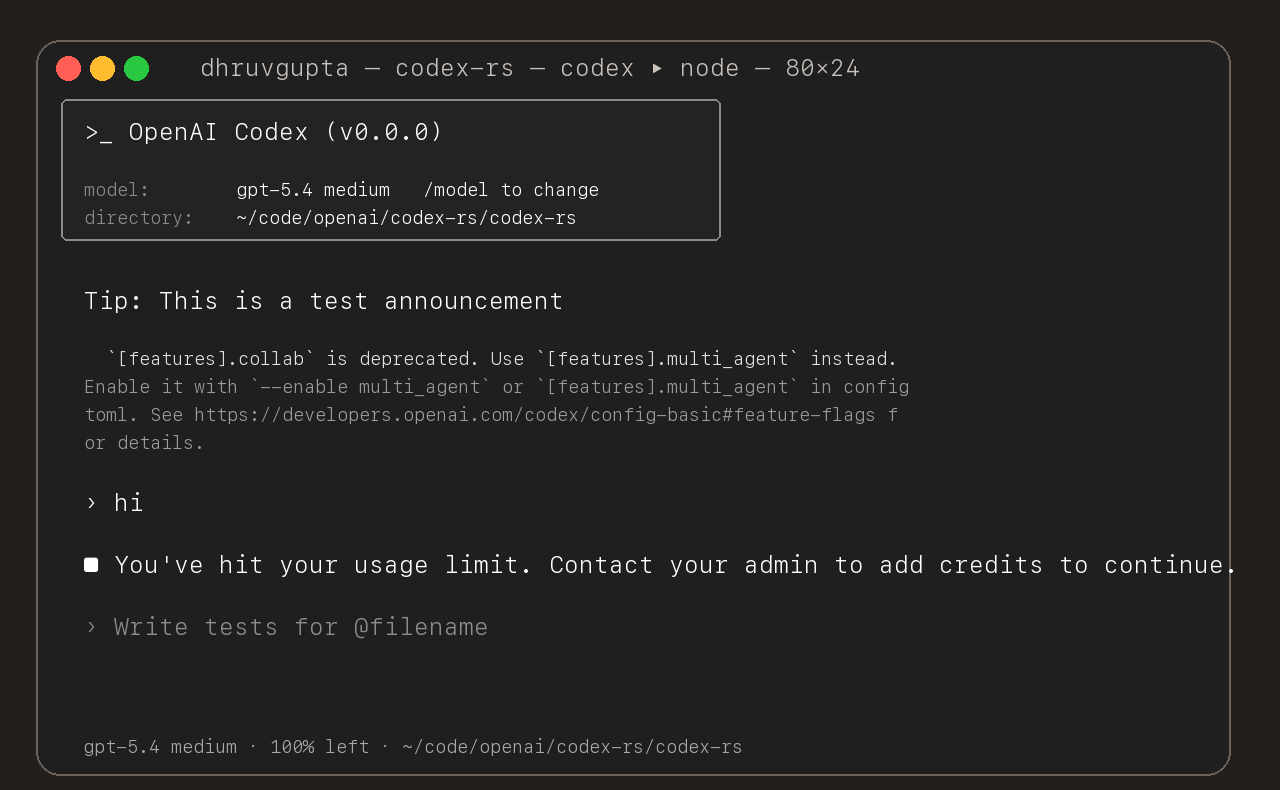
  • [codex-cli][app-server] Update self-serve business usage limit copy in error returned (#15478)
    ## Summary
    - update the self-serve business usage-based limit message to direct
    users to their admin for additional credits
    - add a focused unit test for the self_serve_business_usage_based plan
    branch
    
    Added also: 
    
    If you are at a rate limit but you still have credits, codex cli would
    tell you to switch the model. We shouldnt do this if you have credits so
    fixed this.
    
    ## Test
    - launched the source-built CLI and verified the updated message is
    shown for the self-serve business usage-based plan
    
    ![Test
    screenshot](https://raw.githubusercontent.com/openai/codex/5cc3c013ef17ac5c66dfd9395c0d3c4837602231/docs/images/self-serve-business-usage-limit.png)
  • Add v8-poc consumer of our new built v8 (#15203)
    This adds a dummy v8-poc project that in Cargo links against our
    prebuilt binaries and the ones provided by rusty_v8 for non musl
    platforms. This demonstrates that we can successfully link and use v8 on
    all platforms that we want to target.
    
    In bazel things are slightly more complicated. Since the libraries as
    published have libc++ linked in already we end up with a lot of double
    linked symbols if we try to use them in bazel land. Instead we fall back
    to building rusty_v8 and v8 from source (cached of course) on the
    platforms we ship to.
    
    There is likely some compatibility drift in the windows bazel builder
    that we'll need to reconcile before we can re-enable them. I'm happy to
    be on the hook to unwind that.
  • Add remote env CI matrix and integration test (#14869)
    `CODEX_TEST_REMOTE_ENV` will make `test_codex` start the executor
    "remotely" (inside a docker container) turning any integration test into
    remote test.
  • Use released DotSlash package for argument-comment lint (#15199)
    ## Why
    The argument-comment lint now has a packaged DotSlash artifact from
    [#15198](https://github.com/openai/codex/pull/15198), so the normal repo
    lint path should use that released payload instead of rebuilding the
    lint from source every time.
    
    That keeps `just clippy` and CI aligned with the shipped artifact while
    preserving a separate source-build path for people actively hacking on
    the lint crate.
    
    The current alpha package also exposed two integration wrinkles that the
    repo-side prebuilt wrapper needs to smooth over:
    - the bundled Dylint library filename includes the host triple, for
    example `@nightly-2025-09-18-aarch64-apple-darwin`, and Dylint derives
    `RUSTUP_TOOLCHAIN` from that filename
    - on Windows, Dylint's driver path also expects `RUSTUP_HOME` to be
    present in the environment
    
    Without those adjustments, the prebuilt CI jobs fail during `cargo
    metadata` or driver setup. This change makes the checked-in prebuilt
    wrapper normalize the packaged library name to the plain
    `nightly-2025-09-18` channel before invoking `cargo-dylint`, and it
    teaches both the wrapper and the packaged runner source to infer
    `RUSTUP_HOME` from `rustup show home` when the environment does not
    already provide it.
    
    After the prebuilt Windows lint job started running successfully, it
    also surfaced a handful of existing anonymous literal callsites in
    `windows-sandbox-rs`. This PR now annotates those callsites so the new
    cross-platform lint job is green on the current tree.
    
    ## What Changed
    - checked in the current
    `tools/argument-comment-lint/argument-comment-lint` DotSlash manifest
    - kept `tools/argument-comment-lint/run.sh` as the source-build wrapper
    for lint development
    - added `tools/argument-comment-lint/run-prebuilt-linter.sh` as the
    normal enforcement path, using the checked-in DotSlash package and
    bundled `cargo-dylint`
    - updated `just clippy` and `just argument-comment-lint` to use the
    prebuilt wrapper
    - split `.github/workflows/rust-ci.yml` so source-package checks live in
    a dedicated `argument_comment_lint_package` job, while the released lint
    runs in an `argument_comment_lint_prebuilt` matrix on Linux, macOS, and
    Windows
    - kept the pinned `nightly-2025-09-18` toolchain install in the prebuilt
    CI matrix, since the prebuilt package still relies on rustup-provided
    toolchain components
    - updated `tools/argument-comment-lint/run-prebuilt-linter.sh` to
    normalize host-qualified nightly library filenames, keep the `rustup`
    shim directory ahead of direct toolchain `cargo` binaries, and export
    `RUSTUP_HOME` when needed for Windows Dylint driver setup
    - updated `tools/argument-comment-lint/src/bin/argument-comment-lint.rs`
    so future published DotSlash artifacts apply the same nightly-filename
    normalization and `RUSTUP_HOME` inference internally
    - fixed the remaining Windows lint violations in
    `codex-rs/windows-sandbox-rs` by adding the required `/*param*/`
    comments at the reported callsites
    - documented the checked-in DotSlash file, wrapper split, archive
    layout, nightly prerequisite, and Windows `RUSTUP_HOME` requirement in
    `tools/argument-comment-lint/README.md`
  • Add exec-server exec RPC implementation (#15090)
    Stacked PR 2/3, based on the stub PR.
    
    Adds the exec RPC implementation and process/event flow in exec-server
    only.
    
    ---------
    
    Co-authored-by: Codex <noreply@openai.com>
  • Pin setup-zig GitHub Action to immutable SHA (#14858)
    ### Motivation
    - Pinning the action to an immutable commit SHA reduces the risk of
    arbitrary code execution in runners with repository access and secrets.
    
    ### Description
    - Replaced `uses: mlugg/setup-zig@v2` with `uses:
    mlugg/setup-zig@d1434d0886 # v2` in three
    workflow files.
    - Updated the following files: ` .github/workflows/rust-ci.yml`, `
    .github/workflows/rust-release.yml`, and `
    .github/workflows/shell-tool-mcp.yml` to reference the immutable SHA
    while preserving the original `v2` intent in a trailing comment.
    
    ### Testing
    - No automated tests were run because this is a workflow-only change and
    does not affect repository source code, so CI validation will occur on
    the next workflow execution.
    
    ------
    [Codex
    Task](https://chatgpt.com/codex/tasks/task_i_69763f570234832d9c67b1b66a27c78d)
  • Apply argument comment lint across codex-rs (#14652)
    ## Why
    
    Once the repo-local lint exists, `codex-rs` needs to follow the
    checked-in convention and CI needs to keep it from drifting. This commit
    applies the fallback `/*param*/` style consistently across existing
    positional literal call sites without changing those APIs.
    
    The longer-term preference is still to avoid APIs that require comments
    by choosing clearer parameter types and call shapes. This PR is
    intentionally the mechanical follow-through for the places where the
    existing signatures stay in place.
    
    After rebasing onto newer `main`, the rollout also had to cover newly
    introduced `tui_app_server` call sites. That made it clear the first cut
    of the CI job was too expensive for the common path: it was spending
    almost as much time installing `cargo-dylint` and re-testing the lint
    crate as a representative test job spends running product tests. The CI
    update keeps the full workspace enforcement but trims that extra
    overhead from ordinary `codex-rs` PRs.
    
    ## What changed
    
    - keep a dedicated `argument_comment_lint` job in `rust-ci`
    - mechanically annotate remaining opaque positional literals across
    `codex-rs` with exact `/*param*/` comments, including the rebased
    `tui_app_server` call sites that now fall under the lint
    - keep the checked-in style aligned with the lint policy by using
    `/*param*/` and leaving string and char literals uncommented
    - cache `cargo-dylint`, `dylint-link`, and the relevant Cargo
    registry/git metadata in the lint job
    - split changed-path detection so the lint crate's own `cargo test` step
    runs only when `tools/argument-comment-lint/*` or `rust-ci.yml` changes
    - continue to run the repo wrapper over the `codex-rs` workspace, so
    product-code enforcement is unchanged
    
    Most of the code changes in this commit are intentionally mechanical
    comment rewrites or insertions driven by the lint itself.
    
    ## Verification
    
    - `./tools/argument-comment-lint/run.sh --workspace`
    - `cargo test -p codex-tui-app-server -p codex-tui`
    - parsed `.github/workflows/rust-ci.yml` locally with PyYAML
    
    ---
    
    * -> #14652
    * #14651
  • chore(deps): bump actions/upload-artifact from 6 to 7 (#13207)
    Bumps
    [actions/upload-artifact](https://github.com/actions/upload-artifact)
    from 6 to 7.
    <details>
    <summary>Release notes</summary>
    <p><em>Sourced from <a
    href="https://github.com/actions/upload-artifact/releases">actions/upload-artifact's
    releases</a>.</em></p>
    <blockquote>
    <h2>v7.0.0</h2>
    <h2>v7 What's new</h2>
    <h3>Direct Uploads</h3>
    <p>Adds support for uploading single files directly (unzipped). Callers
    can set the new <code>archive</code> parameter to <code>false</code> to
    skip zipping the file during upload. Right now, we only support single
    files. The action will fail if the glob passed resolves to multiple
    files. The <code>name</code> parameter is also ignored with this
    setting. Instead, the name of the artifact will be the name of the
    uploaded file.</p>
    <h3>ESM</h3>
    <p>To support new versions of the <code>@actions/*</code> packages,
    we've upgraded the package to ESM.</p>
    <h2>What's Changed</h2>
    <ul>
    <li>Add proxy integration test by <a
    href="https://github.com/Link"><code>@​Link</code></a>- in <a
    href="https://redirect.github.com/actions/upload-artifact/pull/754">actions/upload-artifact#754</a></li>
    <li>Upgrade the module to ESM and bump dependencies by <a
    href="https://github.com/danwkennedy"><code>@​danwkennedy</code></a> in
    <a
    href="https://redirect.github.com/actions/upload-artifact/pull/762">actions/upload-artifact#762</a></li>
    <li>Support direct file uploads by <a
    href="https://github.com/danwkennedy"><code>@​danwkennedy</code></a> in
    <a
    href="https://redirect.github.com/actions/upload-artifact/pull/764">actions/upload-artifact#764</a></li>
    </ul>
    <h2>New Contributors</h2>
    <ul>
    <li><a href="https://github.com/Link"><code>@​Link</code></a>- made
    their first contribution in <a
    href="https://redirect.github.com/actions/upload-artifact/pull/754">actions/upload-artifact#754</a></li>
    </ul>
    <p><strong>Full Changelog</strong>: <a
    href="https://github.com/actions/upload-artifact/compare/v6...v7.0.0">https://github.com/actions/upload-artifact/compare/v6...v7.0.0</a></p>
    </blockquote>
    </details>
    <details>
    <summary>Commits</summary>
    <ul>
    <li><a
    href="https://github.com/actions/upload-artifact/commit/bbbca2ddaa5d8feaa63e36b76fdaad77386f024f"><code>bbbca2d</code></a>
    Support direct file uploads (<a
    href="https://redirect.github.com/actions/upload-artifact/issues/764">#764</a>)</li>
    <li><a
    href="https://github.com/actions/upload-artifact/commit/589182c5a4cec8920b8c1bce3e2fab1c97a02296"><code>589182c</code></a>
    Upgrade the module to ESM and bump dependencies (<a
    href="https://redirect.github.com/actions/upload-artifact/issues/762">#762</a>)</li>
    <li><a
    href="https://github.com/actions/upload-artifact/commit/47309c993abb98030a35d55ef7ff34b7fa1074b5"><code>47309c9</code></a>
    Merge pull request <a
    href="https://redirect.github.com/actions/upload-artifact/issues/754">#754</a>
    from actions/Link-/add-proxy-integration-tests</li>
    <li><a
    href="https://github.com/actions/upload-artifact/commit/02a8460834e70dab0ce194c64360c59dc1475ef0"><code>02a8460</code></a>
    Add proxy integration test</li>
    <li>See full diff in <a
    href="https://github.com/actions/upload-artifact/compare/v6...v7">compare
    view</a></li>
    </ul>
    </details>
    <br />
    
    
    [![Dependabot compatibility
    score](https://dependabot-badges.githubapp.com/badges/compatibility_score?dependency-name=actions/upload-artifact&package-manager=github_actions&previous-version=6&new-version=7)](https://docs.github.com/en/github/managing-security-vulnerabilities/about-dependabot-security-updates#about-compatibility-scores)
    
    Dependabot will resolve any conflicts with this PR as long as you don't
    alter it yourself. You can also trigger a rebase manually by commenting
    `@dependabot rebase`.
    
    [//]: # (dependabot-automerge-start)
    [//]: # (dependabot-automerge-end)
    
    ---
    
    <details>
    <summary>Dependabot commands and options</summary>
    <br />
    
    You can trigger Dependabot actions by commenting on this PR:
    - `@dependabot rebase` will rebase this PR
    - `@dependabot recreate` will recreate this PR, overwriting any edits
    that have been made to it
    - `@dependabot show <dependency name> ignore conditions` will show all
    of the ignore conditions of the specified dependency
    - `@dependabot ignore this major version` will close this PR and stop
    Dependabot creating any more for this major version (unless you reopen
    the PR or upgrade to it yourself)
    - `@dependabot ignore this minor version` will close this PR and stop
    Dependabot creating any more for this minor version (unless you reopen
    the PR or upgrade to it yourself)
    - `@dependabot ignore this dependency` will close this PR and stop
    Dependabot creating any more for this dependency (unless you reopen the
    PR or upgrade to it yourself)
    
    
    </details>
    
    Signed-off-by: dependabot[bot] <support@github.com>
    Co-authored-by: dependabot[bot] <49699333+dependabot[bot]@users.noreply.github.com>
    Co-authored-by: Eric Traut <etraut@openai.com>
  • tests(js_repl): stabilize CI runtime test execution (#12407)
    ## Summary
    
    Stabilize `js_repl` runtime test setup in CI and move tool-facing
    `js_repl` behavior coverage into integration tests.
    
    This is a test/CI change only. No production `js_repl` behavior change
    is intended.
    
    ## Why
    
    - Bazel test sandboxes (especially on macOS) could resolve a different
    `node` than the one installed by `actions/setup-node`, which caused
    `js_repl` runtime/version failures.
    - `js_repl` runtime tests depend on platform-specific
    sandbox/test-harness behavior, so they need explicit gating in a
    base-stability commit.
    - Several tests in the `js_repl` unit test module were actually
    black-box/tool-level behavior tests and fit better in the integration
    suite.
    
    ## Changes
    
    - Add `actions/setup-node` to the Bazel and Rust `Tests` workflows,
    using the exact version pinned in the repo’s Node version file.
    - In Bazel (non-Windows), pass `CODEX_JS_REPL_NODE_PATH=$(which node)`
    into test env so `js_repl` uses the `actions/setup-node` runtime inside
    Bazel tests.
    - Add a new integration test suite for `js_repl` tool behavior and
    register it in the core integration test suite module.
    - Move black-box `js_repl` behavior tests into the integration suite
    (persistence/TLA, builtin tool invocation, recursive self-call
    rejection, `process` isolation, blocked builtin imports).
    - Keep white-box manager/kernel tests in the `js_repl` unit test module.
    - Gate `js_repl` runtime tests to run only on macOS and only when a
    usable Node runtime is available (skip on other platforms / missing Node
    in this commit).
    
    ## Impact
    
    - Reduces `js_repl` CI failures caused by Node resolution drift in
    Bazel.
    - Improves test organization by separating tool-facing behavior tests
    from white-box manager/kernel tests.
    - Keeps the base commit stable while expanding `js_repl` runtime
    coverage.
    
    
    #### [git stack](https://github.com/magus/git-stack-cli)
    -  `1` https://github.com/openai/codex/pull/12372
    - 👉 `2` https://github.com/openai/codex/pull/12407
    -  `3` https://github.com/openai/codex/pull/12185
    -  `4` https://github.com/openai/codex/pull/10673
  • fix(linux-sandbox): mount /dev in bwrap sandbox (#12081)
    ## Summary
    - Updates the Linux bubblewrap sandbox args to mount a minimal `/dev`
    using `--dev /dev` instead of only binding `/dev/null`. tools needing
    entropy (git, crypto libs, etc.) can fail.
    
    - Changed mount order so `--dev /dev` is added before writable-root
    `--bind` mounts, preserving writable `/dev/*` submounts like `/dev/shm`
    
    ## Why
    Fixes sandboxed command failures when reading `/dev/urandom` (and
    similar standard device-node access).
    
    
    Fixes https://github.com/openai/codex/issues/12056
  • fix(ci) lock rust toolchain at 1.93.0 to unblock (#11703)
    ## Summary
    CI is broken on main because our CI toolchain is trying to run 1.93.1
    while our rust toolchain is locked at 1.93.0. I'm sure it's likely safe
    to upgrade, but let's keep things stable for now.
    
    ## Testing
    - [x] CI should hopefully pass
  • Fix linux-musl release link failures caused by glibc-only libcap artifacts (#11556)
    Problem:
    The `aarch64-unknown-linux-musl` release build was failing at link time
    with
    `/usr/bin/ld: cannot find -lcap` while building binaries that
    transitively pull
    in `codex-linux-sandbox`.
    
    Why this is the right fix:
    `codex-linux-sandbox` compiles vendored bubblewrap and links `libcap`.
    In the
    musl jobs, we were installing distro `libcap-dev`, which provides
    host/glibc
    artifacts. That is not a valid source of target-compatible static libcap
    for
    musl cross-linking, so the fix is to produce a target-compatible libcap
    inside
    the musl tool bootstrap and point pkg-config at it.
    
    This also closes the CI coverage gap that allowed this to slip through:
    the
    `rust-ci.yml` matrix did not exercise `aarch64-unknown-linux-musl` in
    `release`
    mode. Adding that target/profile combination to CI is the right
    regression
    barrier for this class of failure.
    
    What changed:
    - Updated `.github/scripts/install-musl-build-tools.sh` to install
    tooling
      needed to fetch/build libcap sources (`curl`, `xz-utils`, certs).
    - Added deterministic libcap bootstrap in the musl tool root:
      - download `libcap-2.75` from kernel.org
      - verify SHA256
      - build with the target musl compiler (`*-linux-musl-gcc`)
      - stage `libcap.a` and headers under the target tool root
      - generate a target-scoped `libcap.pc`
    - Exported target `PKG_CONFIG_PATH` so builds resolve the staged musl
    libcap
      instead of host pkg-config/lib paths.
    - Updated `.github/workflows/rust-ci.yml` to add a `release` matrix
    entry for
      `aarch64-unknown-linux-musl` on the ARM runner.
    - Updated `.github/workflows/rust-ci.yml` to set
    `CARGO_PROFILE_RELEASE_LTO=thin` for `release` matrix entries (and keep
    `fat`
    for non-release entries), matching the release-build tradeoff already
    used in
      `rust-release.yml` while reducing CI runtime.
    
    Verification:
    - Reproduced the original failure in CI-like containers:
      - `aarch64-unknown-linux-musl` failed with `cannot find -lcap`.
    - Verified the underlying mismatch by forcing host libcap into the link:
      - link then failed with glibc-specific unresolved symbols
        (`__isoc23_*`, `__*_chk`), confirming host libcap was unsuitable.
    - Verified the fix in CI-like containers after this change:
    - `cargo build -p codex-linux-sandbox --target
    aarch64-unknown-linux-musl --release` -> pass
    - `cargo build -p codex-linux-sandbox --target x86_64-unknown-linux-musl
    --release` -> pass
    - Triggered `rust-ci` on this branch and confirmed the new job appears:
    - `Lint/Build — ubuntu-24.04-arm - aarch64-unknown-linux-musl (release)`
  • ci: capture cargo timings in Rust CI and release workflows (#11543)
    ## Why
    We want actionable build-hotspot data from CI so we can tune Rust
    workflow performance (for example, target coverage, cache behavior, and
    job shape) based on actual compile-time bottlenecks.
    
    `cargo` timing reports are lightweight and provide a direct way to
    inspect where compilation time is spent.
    
    ## What Changed
    - Updated `.github/workflows/rust-release.yml` to run `cargo build` with
    `--timings` and upload `target/**/cargo-timings/cargo-timing.html`.
    - Updated `.github/workflows/rust-release-windows.yml` to run `cargo
    build` with `--timings` and upload
    `target/**/cargo-timings/cargo-timing.html`.
    - Updated `.github/workflows/rust-ci.yml` to:
      - run `cargo clippy` with `--timings`
      - run `cargo nextest run` with `--timings` (stable-compatible)
    - upload `target/**/cargo-timings/cargo-timing.html` artifacts for both
    the clippy and nextest jobs
    
    Artifacts are matrix-scoped via artifact names so timings can be
    compared per target/profile.
    
    ## Verification
    - Confirmed the net diff is limited to:
      - `.github/workflows/rust-ci.yml`
      - `.github/workflows/rust-release.yml`
      - `.github/workflows/rust-release-windows.yml`
    - Verified timing uploads are added immediately after the corresponding
    timed commands in each workflow.
    - Confirmed stable Cargo accepts plain `--timings` for the compile phase
    (`cargo test --no-run --timings`) and generates
    `target/cargo-timings/cargo-timing.html`.
    - Ran VS Code diagnostics on modified workflow files; no new diagnostics
    were introduced by these changes.
  • build(linux-sandbox): always compile vendored bubblewrap on Linux; remove CODEX_BWRAP_ENABLE_FFI (#11498)
    ## Summary
    This PR removes the temporary `CODEX_BWRAP_ENABLE_FFI` flag and makes
    Linux builds always compile vendored bubblewrap support for
    `codex-linux-sandbox`.
    
    ## Changes
    - Removed `CODEX_BWRAP_ENABLE_FFI` gating from
    `codex-rs/linux-sandbox/build.rs`.
    - Linux builds now fail fast if vendored bubblewrap compilation fails
    (instead of warning and continuing).
    - Updated fallback/help text in
    `codex-rs/linux-sandbox/src/vendored_bwrap.rs` to remove references to
    `CODEX_BWRAP_ENABLE_FFI`.
    - Removed `CODEX_BWRAP_ENABLE_FFI` env wiring from:
      - `.github/workflows/rust-ci.yml`
      - `.github/workflows/bazel.yml`
      - `.github/workflows/rust-release.yml`
    
    ---------
    
    Co-authored-by: David Zbarsky <zbarsky@openai.com>
  • feat: remove "cargo check individual crates" from CI (#11475)
    I think this check has outlived its usefulness. It is often one of the
    last CI jobs to finish when we put up a PR, so this should save us some
    time.
  • feat(linux-sandbox): add bwrap support (#9938)
    ## Summary
    This PR introduces a gated Bubblewrap (bwrap) Linux sandbox path. The
    curent Linux sandbox path relies on in-process restrictions (including
    Landlock). Bubblewrap gives us a more uniform filesystem isolation
    model, especially explicit writable roots with the option to make some
    directories read-only and granular network controls.
    
    This is behind a feature flag so we can validate behavior safely before
    making it the default.
    
    - Added temporary rollout flag:
      - `features.use_linux_sandbox_bwrap`
    - Preserved existing default path when the flag is off.
    - In Bubblewrap mode:
    - Added internal retry without /proc when /proc mount is not permitted
    by the host/container.
  • chore: remove deprecated mcp-types crate (#10357)
    https://github.com/openai/codex/pull/10349 migrated us off of
    `mcp-types`, so this PR deletes the code.
    
    ---
    [//]: # (BEGIN SAPLING FOOTER)
    Stack created with [Sapling](https://sapling-scm.com). Best reviewed
    with [ReviewStack](https://reviewstack.dev/openai/codex/pull/10357).
    * __->__ #10357
    * #10349
    * #10356
  • Upgrade to rust 1.93 (#10080)
    I needed to upgrade bazel one to get gnullvm artifacts and then noticed
    monorepo had drifted forward. They should move in lockstep. Also 1.93
    already shipped so we can try that instead.
  • feat: sqlite 1 (#10004)
    Add a `.sqlite` database to be used to store rollout metatdata (and
    later logs)
    This PR is phase 1:
    * Add the database and the required infrastructure
    * Add a backfill of the database
    * Persist the newly created rollout both in files and in the DB
    * When we need to get metadata or a rollout, consider the `JSONL` as the
    source of truth but compare the results with the DB and show any errors
  • feat: introducing a network sandbox proxy (#8442)
    This add a new crate, `codex-network-proxy`, a local network proxy
    service used by Codex to enforce fine-grained network policy (domain
    allow/deny) and to surface blocked network events for interactive
    approvals.
    
    - New crate: `codex-rs/network-proxy/` (`codex-network-proxy` binary +
    library)
    - Core capabilities:
      - HTTP proxy support (including CONNECT tunneling)
      - SOCKS5 proxy support (in the later PR)
    - policy evaluation (allowed/denied domain lists; denylist wins;
    wildcard support)
      - small admin API for polling/reload/mode changes
    - optional MITM support for HTTPS CONNECT to enforce “limited mode”
    method restrictions (later PR)
    
    Will follow up integration with codex in subsequent PRs.
    
    ## Testing
    
    - `cd codex-rs && cargo build -p codex-network-proxy`
    - `cd codex-rs && cargo run -p codex-network-proxy -- proxy`
  • chore: upgrade to Rust 1.92.0 (#8860)
    **Summary**
    - Upgrade Rust toolchain used by CI to 1.92.0.
    - Address new clippy `derivable_impls` warnings by deriving `Default`
    for enums across protocol, core, backend openapi models, and
    windows-sandbox setup.
    - Tidy up related test/config behavior (originator header handling, env
    override cleanup) and remove a now-unused assignment in TUI/TUI2 render
    layout.
    
    **Testing**
    - `just fmt`
    - `just fix -p codex-tui`
    - `just fix -p codex-tui2`
    - `just fix -p codex-windows-sandbox`
    - `cargo test -p codex-tui`
    - `cargo test -p codex-tui2`
    - `cargo test -p codex-windows-sandbox`
    - `cargo test -p codex-core --test all`
    - `cargo test -p codex-app-server --test all`
    - `cargo test -p codex-mcp-server --test all`
    - `cargo test --all-features`
  • upgrade runners in rust-ci.yml to use the larger runners (#9106)
    Upgrades runners in rust-ci.yaml to larger runners
    
    ubuntu-24.04 (x64 and arm64) -> custom 16 core ubuntu 24.04 runners
    macos-14 -> mac0s-15-xlarge
    [TODO] windows (x64 and arm64) -> custom 16 core windows runners